

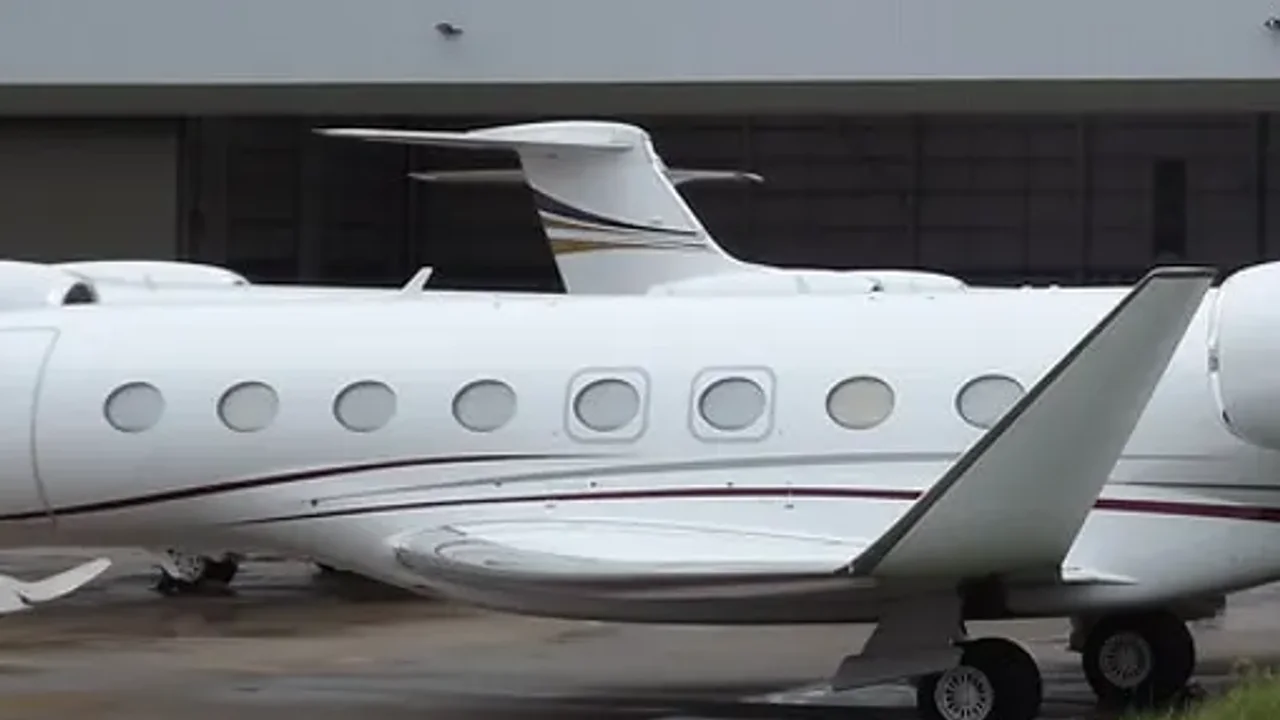
The best private jets for coast-to-coast flights are super midsize jets such as the Challenger 350, Citation Longitude, Praetor 600 and Gulfstream G280, which fly New York to Los Angeles nonstop in about 5 hours with a comfortable margin. Longer-range midsize jets such as the Citation Latitude also make it nonstop. Light jets usually need one fuel stop.
Key takeaways
- New York to Los Angeles is about 2,130 nm, which sets the bar for a nonstop.
- Super midsize jets are the classic choice: nonstop with margin, stand-up cabins, 8 to 10 seats.
- Some midsize jets can fly it nonstop too, at a lower hourly rate.
- Light jets usually stop once, adding a landing, time on the ground and another climb.
- Winds matter: westbound winter flights can take an hour or more longer than eastbound ones.
Which private jets can fly coast to coast nonstop?
Any jet whose planning range comfortably exceeds about 2,130 nm, the great-circle distance from Teterboro to Van Nuys. Our tools plan with 85% of published range to allow for winds, reserves and passengers. Models from the aircraft data behind our tools:
| Aircraft | Class | Published range | Planning range | Nonstop NY–LA? |
|---|---|---|---|---|
| Citation CJ4 | Light | 2,165 nm | ~1,840 nm | Usually one stop |
| Phenom 300E | Light | 2,010 nm | ~1,710 nm | Usually one stop |
| Citation Latitude | Midsize | 2,700 nm | ~2,295 nm | Yes |
| Hawker 900XP | Midsize | 2,930 nm | ~2,490 nm | Yes |
| Challenger 300/350 | Super midsize | ~3,200 nm | ~2,720 nm | Yes, with margin |
| Citation Longitude | Super midsize | 3,500 nm | ~2,975 nm | Yes, with margin |
| Gulfstream G280 | Super midsize | ~3,600 nm | ~3,060 nm | Yes, with margin |
| Praetor 600 | Super midsize | ~4,018 nm | ~3,415 nm | Yes, with margin |
Manufacturers publish the details: Cessna lists the Citation Longitude at a maximum range of 3,500 nm and the Citation Latitude at 2,700 nm, and the Citation CJ4 Gen3 at 2,165 nm. Published ranges assume light loads and reserves. With a full cabin, bags and strong headwinds, a jet near the limit may need a stop on the day, so the operator makes the final call. For the four super midsize jets in detail, see super midsize jets compared.
How long does a coast-to-coast private flight take?
About 5 to 6 hours in still air, depending on the class and any stop. Estimated times from Teterboro to Van Nuys at typical class speeds:
| Class | Typical cruise | Fuel stops | Est. time |
|---|---|---|---|
| Light jet | ~440 kts | 1 | 6 h 00 min |
| Midsize jet (longer-range models) | ~445 kts | 0 | 5 h 20 min |
| Super midsize jet | ~465 kts | 0 | 5 h 07 min |
| Heavy jet | ~470 kts | 0 | 5 h 04 min |
Times include about 18 minutes for taxi, climb and descent and about 36 minutes for a fuel stop, as in our flight time calculator, which also lets you add wind.
Why westbound takes longer
Winds at cruising altitude usually blow from west to east, often strongly in winter. As an example, a 60-knot wind component changes a super midsize jet's still-air 5 h 07 min to about 4 h 33 min eastbound or 5 h 53 min westbound. On days with very strong headwinds, even a jet with good range may need a fuel stop flying west.
How much does a coast-to-coast private flight cost?
Estimates for six passengers between Teterboro and Van Nuys, using the same method as our charter flight cost estimator, including landing and handling fees, any fuel stop, US excise tax and segment fees:
| Class | One way (includes empty return) | Round trip, 3 nights away |
|---|---|---|
| Light jet, one stop | $42,200–$78,000 | $56,300–$85,200 |
| Midsize jet, nonstop | $46,500–$83,900 | $61,400–$90,400 |
| Super midsize jet | $58,000–$109,600 | $76,000–$116,500 |
| Heavy jet | $75,200–$144,400 | $97,700–$152,300 |
The light jet's lower hourly rate is partly offset by its extra time and the second landing, so a nonstop midsize jet often costs little more. One-way prices assume the aircraft flies back empty; if it has an onward booking or you find an empty leg, the price can drop sharply. These are planning estimates, not quotes.
When does a light jet with a fuel stop make sense?
When you are a small group, flexible on time and watching the budget. A light jet such as the Phenom 300E or Citation CJ4 can still be a good choice:
- Two to four passengers with modest baggage.
- A stop on the way that suits you, for example a meeting in Denver or Kansas City.
- Eastbound flights, where tailwinds reduce the time and sometimes allow a longer leg.
- Availability, when no midsize or super midsize jet is free on your dates.
The trade-offs are a smaller cabin without stand-up headroom, limited baggage and about an hour more overall. On a five- or six-hour trip, a stand-up cabin and an enclosed lavatory make a real difference, which is why super midsize jets are the usual choice. See turboprop vs light jet and light vs midsize vs heavy jets for how the classes compare.
Can you fly coast to coast and back in one day?
Rarely with one crew. A same-day round trip from New York to Los Angeles and back is about 10 to 11 hours of flying in still air, before any delays. Under 14 CFR 135.267, a two-pilot crew on an unscheduled charter may not fly more than 10 hours of flight time in 24 hours, and must have at least 10 consecutive hours of rest before the assignment ends.
In practice, that leaves three options:
- Stay overnight. The usual choice: the crew rests and you fly back the next day or later. Expect crew overnight costs on the invoice.
- Swap crews. The operator positions a fresh crew to the far end for the return. This adds cost and is not always possible.
- Use a larger crew. Some operators can provide a third pilot on suitable aircraft, which changes the duty limits; ask whether this is possible and what it costs.
If your plans involve a long same-day trip, mention it when you request quotes so the operator can plan the crew. Our guide to charter fees explains how overnight and crew charges appear on a quote.
Nonstop or one stop: how to choose
Think about time, comfort and how the stop fits your day. A nonstop super midsize or longer-range midsize jet saves about 40 minutes over a light jet with a stop, avoids a second landing and keeps you in a bigger cabin. A stop costs time but can lower the price, especially for two to four passengers.
Questions to ask the broker:
- Is a nonstop realistic on my date, given the forecast winds and our load?
- Where would the stop be, and how long on the ground?
- What is the price difference between the light jet with a stop and a nonstop midsize or super midsize?
- Are there empty legs heading the same way on nearby dates?
Comfort on a five-hour flight
On a coast-to-coast trip, cabin features matter as much as speed. Ask about:
- Stand-up headroom: super midsize and heavy jets have cabins around 6 feet high; most light jets do not.
- Lavatory: an enclosed lavatory is common on larger jets and worth confirming on any aircraft.
- Wi-Fi: air-to-ground systems work across the contiguous US; see private jet Wi-Fi.
- Catering: a full galley allows hot meals on larger jets; see private jet catering.
- Baggage: golf bags, skis and large suitcases fit more easily in super midsize holds.
- Rest: on an overnight eastbound flight, seats that recline fully or a divan that converts to a bed let you arrive in New York more rested. Ask about the seating layout of the specific aircraft.
Popular coast-to-coast routes
The same logic applies to other transcontinental routes. Approximate straight-line distances:
- New York to Los Angeles: about 2,130 nm. See Los Angeles private jet airports and New York private jet airports.
- Miami to Los Angeles: about 2,035 nm.
- New York to San Francisco: about 2,225 nm. See private jet airports near San Francisco.
For each, a super midsize jet is the safe nonstop choice, and a longer-range midsize jet often works with a smaller group.
Get quotes for your coast-to-coast trip
Request a quote with your route, dates, group size and baggage. We will compare aircraft from certificated operators, name each aircraft and operator, and tell you whether the trip is likely to need a fuel stop on your date.