

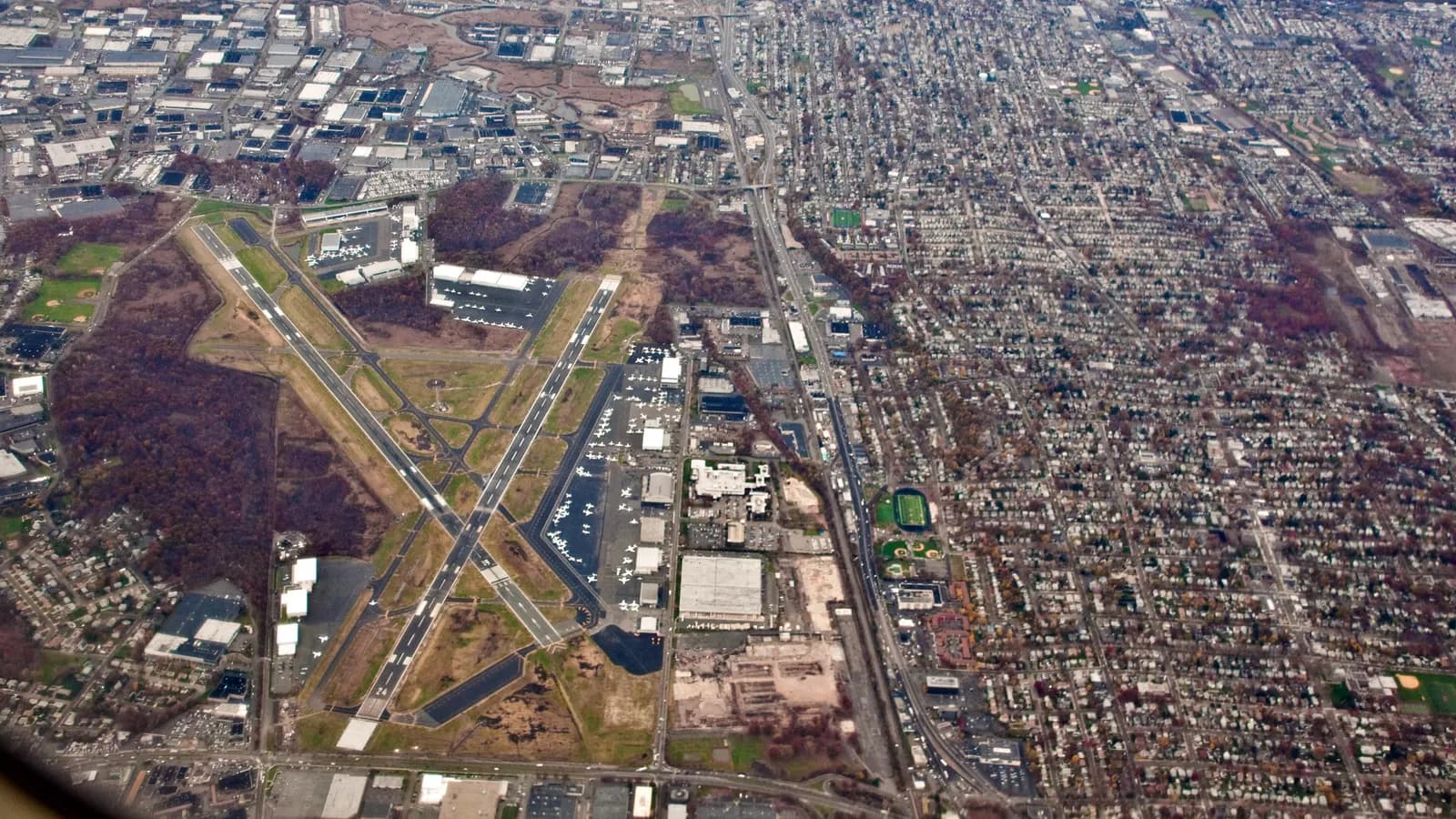
There is no private jet airport inside New York City itself, so the main private airport in New York for Manhattan is Teterboro (TEB) in New Jersey, about 8 miles from Midtown in a straight line. Westchester County Airport (HPN) suits Westchester and Connecticut, Republic (FRG) Long Island, and Morristown (MMU) northern New Jersey. Stewart (SWF), 52 miles north, has a runway long enough for the largest jets.
Key takeaways
- Teterboro is closest to Manhattan, with no airline service, several FBOs and customs on the field. It limits aircraft to an actual weight of 100,000 lb.
- Westchester suits Greenwich, Westchester County and southern Connecticut, and has a voluntary midnight to 6:30 a.m. curfew.
- Republic in Farmingdale is the Long Island option, about halfway between Manhattan and the Hamptons.
- Morristown serves northern New Jersey suburbs, with user-fee customs on weekdays.
- Stewart has an 11,817-foot runway, useful for very large or fully fueled long-range jets.
The airport you choose rarely changes the price much; the aircraft and flight time do. To see a typical range for your route before you decide, try the private jet cost calculator.
Is there a private airport in New York?
Not inside New York City for jets. The only airports within the city limits are JFK and LaGuardia, both busy airline airports. Manhattan also has three public heliports, at Downtown Manhattan/Wall Street, East 34th Street and West 30th Street, according to the New York City Council's helicopter page, but they take helicopters only.
So when people search for a private airport in New York, the practical answer is a ring of general aviation airports around the city:
- Teterboro (TEB), across the Hudson in New Jersey, owned by the Port Authority of New York and New Jersey and built around private and business flying. It has no scheduled airline service.
- Westchester County Airport (HPN), in New York State just north of the city, near White Plains. It has some airline service, but private flights use their own FBO terminals.
- Republic (FRG) on Long Island, Morristown (MMU) in New Jersey and Stewart (SWF) in the Hudson Valley, each the better choice for a particular part of the region.
None of these is "private only" in a legal sense: they are public-use airports, open to any properly equipped aircraft. What makes them private jet airports is the traffic mix and the facilities. The FBO, a private terminal where you meet the crew and walk to the aircraft, replaces the airline terminal and the security line.
Which private jet airports near New York City are best?
Five general aviation airports handle most private flights for the New York area: Teterboro, Westchester, Republic, Morristown and Stewart. JFK, Newark and LaGuardia accept private jets too, but their airline traffic makes them a poor fit for most charters.
| Airport | Main runway | Straight-line distance to Midtown | Customs | Best for |
|---|---|---|---|---|
| Teterboro (TEB), NJ | 6,997 x 150 ft | 8 miles | Yes | Manhattan, Bergen County |
| Westchester County (HPN), NY | 6,549 x 150 ft | 26 miles | Yes | Westchester, Greenwich, southern Connecticut |
| Republic (FRG), Farmingdale, NY | 6,833 x 150 ft | 30 miles | Yes | Long Island, a stop toward the Hamptons |
| Morristown (MMU), NJ | 5,998 x 150 ft | 23 miles | Yes, user fee | Morris and Essex County suburbs, Short Hills |
| Stewart (SWF), NY | 11,817 x 150 ft | 52 miles | Yes, user fee | Hudson Valley, the largest jets |
Runway figures are from the FAA airport data published on AirNav, for example Teterboro's listing. Distances are straight-line from each airport to Midtown Manhattan. By road, every one of them can take far longer at rush hour.
Why is Teterboro the main private jet airport for Manhattan?
Teterboro is the closest airport to Manhattan that is built entirely around private and business aviation. It is owned by the Port Authority of New York and New Jersey and has no scheduled airline service. Its two runways, about 7,000 and 6,000 feet long, handle everything from light jets to most heavy jets.
It is also the busiest private jet airport in the country. In 2025 it recorded 75,029 business aircraft departures, far ahead of second-placed Dallas Love Field with 41,379, according to ARGUS TRAQPak data published in 2025's busiest US private jet airports. That volume is why the FBOs are large and well practiced, and also why peak-hour departures can wait in line for the runway.
What to know about Teterboro:
- Distance: about 8 miles from Midtown in a straight line and about 10 from Wall Street. The drive into Manhattan uses the Lincoln Tunnel or the George Washington Bridge, so traffic, not distance, decides how long it takes.
- FBOs: Signature Aviation has several terminals, and Jet Aviation and Atlantic Aviation also operate there. The operator chooses the FBO, and you can ask for a preference.
- Customs: CBP processes international general aviation flights on the field, according to CBP's Teterboro page, so you can fly straight in from Europe or the Caribbean.
- Noise: Runway 24 has a maximum noise limit, stricter at night (80 decibels from 10 p.m. to 7 a.m.) than during the day (90 decibels). The operator plans departures around it.
Teterboro's 100,000-pound weight limit
No aircraft with an actual gross weight over 100,000 lb may land, take off or taxi at Teterboro without the airport manager's permission. The Port Authority's 100,000 Pound Aircraft Certification Form sets out the rule. A jet certified to weigh more can still use the airport if it keeps its actual weight at or below 100,000 lb, but the operator must send weight-and-balance paperwork at least 72 hours before the flight.
For almost all charters, this makes no difference: light, midsize, super midsize and most heavy jets weigh well under 100,000 lb. It matters for the biggest ultra long range jets, such as the Global 7500. To stay under the limit, they may have to carry less fuel. For a nonstop flight to Asia or the Middle East at full fuel, the operator may plan the departure from another airport.
When is Westchester (HPN) the better choice?
Westchester is the better choice for Greenwich, Westchester County, southern Connecticut and the northern suburbs. It is about 5 miles from Greenwich in a straight line, compared with about 26 miles from Teterboro, and the trip avoids the Hudson River crossings into Manhattan.
What to know about Westchester:
- Runways: the main runway is 6,549 feet long. Aircraft heavier than 120,000 lb maximum takeoff weight need prior permission.
- Voluntary curfew: the county asks all operators to refrain from flying between midnight and 6:30 a.m. Its noise abatement page says this is "not a mandatory curfew, but a voluntary program," and the noise office contacts operators who fly during those hours.
- FBOs: Signature Aviation and Atlantic Aviation each have two terminals, and Million Air also operates there.
- Customs: CBP processes international arrivals at Westchester, which is listed among CBP's biometric entry locations.
HPN also has airline service, but private flights use separate FBO terminals. Westchester private jet traffic is growing quickly: the same ARGUS figures rank it third in the US for 2025, with 36,921 business aircraft departures, up 11.9% on 2024. That makes the New York area the only market with two airports in the national top three.
What about Long Island and the Hamptons?
Republic Airport (FRG) in Farmingdale is the main private jet airport for Long Island. It is about 30 miles from Midtown in a straight line and has a 6,833-foot main runway, two FBOs (Atlantic Aviation and Modern Aviation), voluntary noise abatement procedures and a CBP office for international arrivals. Landing fees apply to all non-military aircraft.
Republic is about 66 miles from East Hampton in a straight line, so it is a useful option when you want a long runway for a larger jet and are willing to drive or take a short helicopter hop for the rest of the way. Smaller aircraft can fly closer to the Hamptons, but local rules and seasonal restrictions change often, so check the current situation with your operator.
For short hops between Manhattan and the Hamptons, a helicopter is often faster than any jet. See when a helicopter beats a jet or book a helicopter.
Morristown and Stewart: the quieter alternatives
Morristown (MMU) is the best choice for northern New Jersey suburbs, and Stewart (SWF) for the Hudson Valley and the largest jets.
- Morristown is about 6 miles from Short Hills and 23 miles from Midtown in a straight line. Its main runway is 5,998 feet, and Atlantic Aviation and Signature Aviation operate there. Customs is a user-fee service listed on CBP's user fee facilities list, with limited weekday hours, so international arrivals need careful timing.
- Stewart in New Windsor, about 52 miles north of Midtown, has an 11,817-foot runway. That is the longest runway of the five airports in the table above, giving the heaviest jets room to take off fully fueled for very long flights. It is also a user-fee customs airport, with Atlantic Aviation and Signature Aviation on the field.
Neither is as convenient for Manhattan as Teterboro, but both can be less congested on busy days.
Can you fly a private jet into JFK, Newark or LaGuardia?
Yes, but it is rarely the best choice. These are some of the busiest airline airports in the US. Private flights compete with airline traffic for runway time and taxi times can be long, while the private terminals at Teterboro or Westchester are closer to most passengers' destinations.
The main reasons to use them are a direct connection to an airline flight, a very large aircraft or a need to fly at hours when other airports are less practical. Your operator or broker can tell you whether a big-airport arrival makes sense for your trip.
How do you choose the right New York airport?
Choose by where you are going, the size of the aircraft and whether you are flying internationally. Straight-line distances from each airport, in statute miles:
| Destination | TEB | HPN | FRG | MMU | SWF |
|---|---|---|---|---|---|
| Midtown Manhattan | 8 | 26 | 30 | 23 | 52 |
| Wall Street | 10 | 30 | 31 | 22 | 55 |
| Greenwich, CT | 26 | 5 | 23 | 44 | 41 |
| Short Hills, NJ | 16 | 39 | 48 | 6 | 54 |
| East Hampton | 98 | 80 | 66 | 117 | 107 |
A few rules of thumb:
- Going to Manhattan: Teterboro, unless you are coming from the north or east and Westchester is quicker at that time of day.
- Going to Connecticut or Westchester: Westchester.
- Going to Long Island: Republic, or a helicopter for the Hamptons.
- Flying a very large jet a very long way: ask whether Teterboro's weight limit affects the trip. Westchester or Stewart may work better.
- Arriving from abroad: confirm customs hours at the chosen airport before you book.
For the wider picture, see our guide to private aviation hubs across the Northeast, from Boston to Washington, and our ranking of the top private jet airports in the US.
How much does a private jet from New York cost?
The cost depends on the aircraft class and flight time, not on which New York airport you use. Some typical routes from Teterboro, in straight-line distance: about 900 nm to Palm Beach, about 950 nm to Miami-Opa Locka, about 1,500 nm to Aspen and about 2,130 nm to Van Nuys.
| Class | Typical hourly rate | Typical New York trips |
|---|---|---|
| Light jet | $4,000–5,900 | Florida, Chicago, the Caribbean with a stop |
| Midsize jet | $5,000–7,200 | Florida and the Midwest with more space |
| Super midsize jet | $6,500–9,800 | Coast to coast nonstop |
| Heavy jet | $8,500–13,000 | Transatlantic nonstop |
Rates are typical US on-demand ranges per flight hour, before taxes and fees; quotes vary with season, availability and positioning. Airport fees, FBO handling and customs charges are added to the quote. New York is a busy market, so ask about empty legs. Use the flight time calculator and the charter cost calculator to estimate your trip, and see our guides to private jets to Miami and private jets to Aspen for two of the most popular routes.
What should you check before booking a New York departure?
Confirm the airport, the FBO, the ground transfer time and any airport rule that could affect the aircraft. Most surprises on New York trips come from traffic on the ground, not in the air.
A short checklist to run through with the operator or your charter advisor:
- Which airport and which FBO? Teterboro and Westchester each have several separate FBO terminals. Put the FBO name and address in your car booking, not just the airport.
- How long is the drive at your departure time? Straight-line miles mean little at 5 p.m. on a Friday. Leave room for the tunnels and bridges into New Jersey, or the parkways north to Westchester.
- Does the aircraft fit the airport's rules? Ask about Teterboro's 100,000 lb limit for the largest jets, Westchester's voluntary midnight to 6:30 a.m. curfew and any noise limits on late departures.
- Is customs available when you land? For an arrival from abroad, check that CBP is staffed at your arrival time, and book the slot early at the user-fee airports, Morristown and Stewart.
- How long is the flight? The flight time calculator gives a realistic block time for your route and aircraft class, which also tells you whether a light jet can fly nonstop or needs a fuel stop.
- What does the quote include? Ask whether landing fees, FBO handling, overnight crew costs and de-icing are included. Winter de-icing in New York can add a noticeable amount to a quote.
If your plans are flexible, also ask about one-way repositioning flights out of the New York airports, listed on our empty legs page.
Planning your trip
For most Manhattan trips, Teterboro is the right answer. For Connecticut and Westchester, it is Westchester; for Long Island, Republic. Morristown and Stewart fill specific needs. Tell us where you are going, how many people are traveling and when, and request a quote. We will match you with an operator, aircraft and airport that fit the trip.