

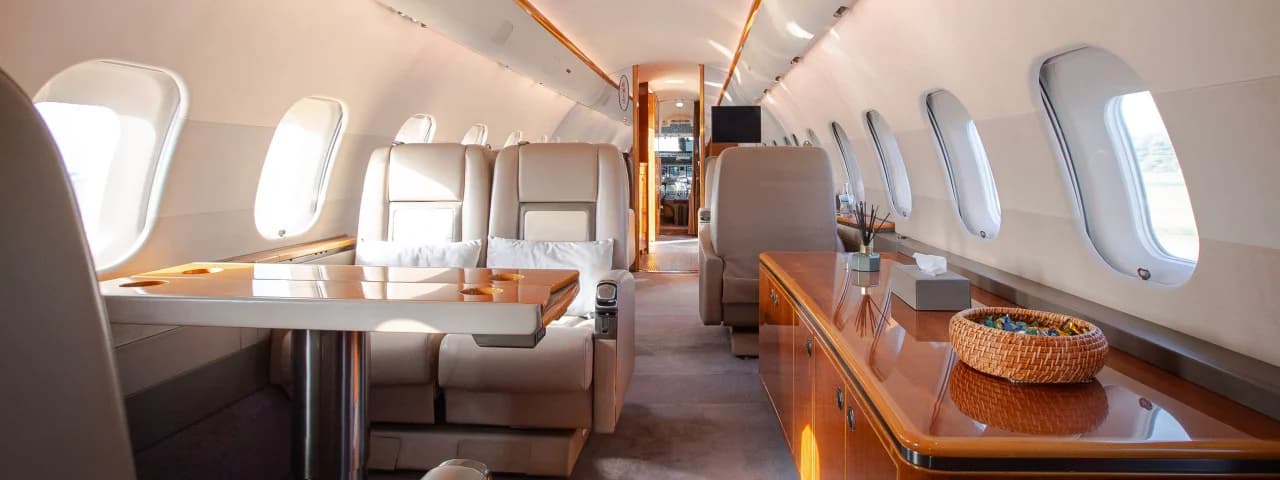
The right private jet size is the smallest aircraft that carries your group and bags nonstop in comfort. As a rule: a turboprop or very light jet for 1 to 5 people on short hops, a light jet for up to 7 people under three hours, a midsize or super midsize jet for longer domestic trips, and a heavy or ultra long range jet for oceans and big groups.
Key takeaways
- There are seven fixed-wing charter classes: turboprop, very light, light, midsize, super midsize, heavy and ultra long range. Each step up adds seats, range, cabin height and cost.
- Typical US charter rates run from about $2,000 per hour for a turboprop to $17,500 for an ultra long range jet (as of October 2026, before taxes and fees).
- Choose by four things in this order: distance, passengers, baggage and the runway at each end.
- Cabin height changes at the midsize class: below it you sit, from it upward most people can stand.
- Buy the range you need with a margin. A fuel stop adds time, but an oversized jet on a short hop adds cost and nothing else.
What are the private jet size classes?
Private aircraft for charter fall into seven classes, defined by cabin size and range rather than by any official rule. Manufacturers and brokers use slightly different boundaries, so treat these as working groups, not legal categories.
- Turboprops: turbine engines driving propellers. Slower, but economical on short sectors and able to use short or unpaved strips.
- Very light jets: the entry point to jet travel, with 4 to 6 seats and regional range.
- Light jets: the most popular charter class in the US, with 6 to 8 seats and range for most two- to three-hour trips.
- Midsize jets: the first class with a near stand-up cabin and an enclosed lavatory.
- Super midsize jets: six-foot, flat-floor cabins with transcontinental range.
- Heavy jets: large cabins with separate zones, full galleys and transatlantic range.
- Ultra long range jets: the flagships, flying 6,000 nm and more nonstop.
Helicopters sit outside this ladder. They are for short transfers, not for distance, and are covered on our helicopter page.
How do private jet sizes compare?
The table below brings the main numbers together. Seats are typical executive configurations, range is the manufacturer's published figure with reserves and a light load, and hourly rates are typical US on-demand retail ranges as of October 2026, before taxes and fees. Quotes vary by operator, aircraft age, base and season.
| Class | Seats | Range (nm) | Cruise (kts) | Cabin height | Baggage (cu ft) | Typical rate per hour |
|---|---|---|---|---|---|---|
| Turboprop | 6–9 | 1,100–1,800 | ~290–310 | ~4.8 ft | 40–71 | $2,000–$3,400 |
| Very light jet | 4–6 | 1,100–1,550 | ~340–420 | 4.5–4.9 ft | 57–70 | $3,000–$4,300 |
| Light jet | 6–8 | 1,500–2,200 | ~415–465 | 4.75–4.9 ft | 53–84 | $4,000–$5,900 |
| Midsize jet | 7–9 | 1,800–2,900 | ~435–470 | 5.7–6.0 ft | 50–127 | $5,000–$7,200 |
| Super midsize jet | 8–10 | 3,100–4,000 | ~460–485 | 5.7–6.25 ft | 100–155 | $6,500–$9,800 |
| Heavy jet | 10–16 | 3,400–6,000 | ~460–490 | 6.0–6.2 ft | 115–286 | $8,500–$13,000 |
| Ultra long range jet | 12–17 | 6,000–7,700 | ~460–515 | 6.2–6.4 ft | 140–226 | $11,000–$17,500 |
Two patterns stand out. Speed barely changes from light jets upward, so a larger jet is not much faster on a domestic trip; what you buy is range, space and payload. And the hourly rate roughly doubles from light to heavy, so the question is always whether the extra range and cabin are doing real work on your route.
Which size suits which trip?
The quickest way to choose is to match the class to the distance first, then check passengers and bags. Distances below are great-circle figures; real routings run a little longer.
| Typical trip | Distance | Usually the right class |
|---|---|---|
| Los Angeles (Van Nuys) to Las Vegas | ~200 nm | Turboprop, very light or light jet |
| Los Angeles to Aspen | ~630 nm | Light jet (check runway and season) |
| New York (Teterboro) to Palm Beach | ~900 nm | Light or midsize jet |
| New York to Los Angeles | ~2,130 nm | Super midsize jet nonstop; light jet with a stop |
| Los Angeles to Honolulu | ~2,220 nm over water | Super midsize jet or larger |
| New York to London | ~3,000 nm | Long-range super midsize or heavy jet |
| Los Angeles to London | ~4,730 nm | Heavy jet with long range |
| New York to Tokyo | ~5,870 nm | Ultra long range jet |
| Los Angeles to Sydney | ~6,510 nm | Only the longest-range ultra long range jets |
For any specific city pair, the range explorer shows which aircraft can make it nonstop, and the flight time calculator estimates time in the air. Both use a planning range of 85% of the published figure, which allows for a full cabin and headwinds.
Turboprops and very light jets: short hops for small groups
Turboprops are the most economical way to fly privately on trips under about 500 miles. The Pilatus PC-12 NGX seats around 8 and cruises at about 290 knots; Pilatus says the type can use short runways and unpaved grass, gravel or snow strips, which opens up ranches, islands and mountain airfields that jets cannot reach. The King Air 350i adds a ninth seat and 71 cu ft of baggage space. The trade-offs are speed, a lower cruising altitude (30,000 to 35,000 ft, so more weather) and, usually, no enclosed lavatory.
Very light jets give you jet speed at close to turboprop cost. The HondaJet Elite II (5 seats, 1,547 nm, 422 kts) and Citation M2 Gen2 (6 seats, 1,550 nm) suit one to four passengers on flights of one to two hours. The Phenom 100EX has a generous 70 cu ft of baggage for its size. Cabins are 4.5 to 4.9 ft tall, so this is a seated experience.
Light jets: the US workhorse
Light jets carry up to 7 passengers on flights of one to three hours, and they are the most popular charter class in the US. They cruise at roughly 415 to 465 knots and reach many smaller airports close to where people actually want to go.
- Phenom 300E: 7 seats, 2,010 nm, 464 kts and 84 cu ft of baggage, the largest hold among the light jets we list. Embraer reports, using GAMA delivery data, that the Phenom 300 series was the world's most delivered light jet for the 13th consecutive year in 2024.
- Citation CJ3+: 7 seats and 2,040 nm, a common choice for regional business travel.
- Citation CJ4 Gen2: the longest-range light jet in our data at 2,165 nm.
- Learjet 45XR: 8 seats and a 51,000 ft ceiling; out of production but widely available for charter.
The limits are cabin height (under 5 ft) and range. After the 85% planning margin, most light jets cover about 1,700 to 1,850 nm, so New York to Los Angeles usually means a fuel stop, which typically adds 30 to 45 minutes.
Midsize and super midsize jets: stand-up comfort and real range
Midsize jets are the first class where most people can stand, with cabins of about 5.7 to 6 ft and an enclosed lavatory. They suit up to 8 passengers on flights of two to four hours.
The standout is the Citation Latitude: a 6 ft flat-floor cabin, 9 seats, 2,700 nm of range and 127 cu ft of baggage, which is more like a super midsize cabin at a midsize rate. The Citation Excel/XLS is the long-serving alternative, with a 5.7 ft cabin and 90 cu ft of baggage but a shorter 1,850 nm range. The Hawker 800XP and Gulfstream G150 round out the class.
Super midsize jets are the reliable choice for coast-to-coast nonstop with 8 to 10 passengers. They add six-foot, flat-floor cabins and, on many aircraft, Wi-Fi and a full galley.
- Challenger 300/350: the benchmark for US transcontinental trips, with 3,200 nm of range and a 6.1 ft cabin.
- Gulfstream G280: 3,600 nm, a 6.25 ft cabin and 154 cu ft of baggage.
- Citation Longitude: 3,500 nm and the fastest cruise in our super midsize data at 483 kts.
- Praetor 600 and Falcon 2000LXS: about 4,000 nm, enough for New York to London nonstop in most conditions.
Heavy and ultra long range jets: oceans, big groups and overnight flights
Heavy jets carry 10 to 16 passengers and fly transatlantic nonstop, with separate cabin zones, full galleys and seats that convert to beds.
- Legacy 600/650: 13 seats and 286 cu ft of baggage, the largest hold of any aircraft in our data. A strong choice for ski groups and long stays.
- Challenger 605/650: 12 seats and 4,000 nm.
- Gulfstream G450 and GIV-SP: 4,220 to 4,350 nm with the classic Gulfstream oval windows.
- Falcon 7X: 5,950 nm, enough for Los Angeles to London nonstop.
Ultra long range jets fly 6,000 to 7,700 nm, and the longest-range models in the class fly city pairs such as New York to Tokyo or New York to Dubai nonstop. The Global 7500 (7,700 nm, four living spaces plus a crew rest area) and Gulfstream G650ER (7,500 nm, a 6.4 ft cabin and 516 kts cruise) lead the class; the Falcon 8X, Gulfstream G550 and Global 6000 offer 6,000 to 6,750 nm, usually at a lower rate. Even at this end, the very longest routes such as Los Angeles to Sydney are at the edge of what any business jet can fly with full tanks and favorable winds.
How do you choose the right private jet size?
Work through distance, passengers, baggage and runway in that order. The first constraint that rules out a class decides it.
1. Distance
Find the nonstop distance and compare it with each class's planning range. If the route is near the limit, ask whether a stop is acceptable. One 30- to 45-minute fuel stop in a light jet can cost less than a super midsize nonstop; on longer or time-critical trips, the nonstop usually wins door to door.
2. Passengers
Seat counts are maximums. On flights over two hours, aim for one or two empty seats so people can stretch out Every passenger, including children, needs a seat; ask the operator about infants.
3. Baggage
Bags are the most common reason to move up a class. A light jet's 53 to 84 cu ft fills quickly with skis, golf clubs or hard-shell cases. Tell your advisor about anything bulky, and pack soft bags where you can.
4. Runways and airports
Larger jets need longer runways, and some airports limit weight or noise, so a short field, high altitude or hot day can rule out an aircraft or force it to carry less fuel. Mountain and island airports are where turboprops and light jets shine. For more on airport choice, see our guide to the top private jet airports in the US.
5. Time aloft and comfort
Under two hours, almost everyone is comfortable in a light jet. From three hours, a stand-up cabin and a proper lavatory make a real difference. Overnight, a heavy or ultra long range jet lets people sleep flat.
Mistakes to avoid when choosing a jet size
- Overbuying. A heavy jet on a one-hour hop costs far more and arrives at almost the same time. The right aircraft is the smallest one that does the job comfortably.
- Trusting the brochure range. Published range assumes a light load and reserves; a full cabin, headwinds or a winter route can cut it noticeably.
- Forgetting the return. On one-way trips, repositioning can make a nearby larger jet cheaper than a smaller one based far away. See how to save money on a charter and empty legs.
- Ignoring aircraft age and specification. Two jets of the same model can differ in interior, Wi-Fi and refurbishment date. Ask for photos and the year of the interior.
- Comparing quotes across classes without asking why. A cheaper quote may be a smaller aircraft that needs a stop. Our guide to private jet charter cost explains what is included.
Next step
Browse every class and model in the aircraft hub, test your route in the range explorer, and estimate a budget with the private jet charter cost calculator. When you are ready, request a quote with your route, group size and baggage, and an advisor will suggest the class that fits and one alternative either side.