

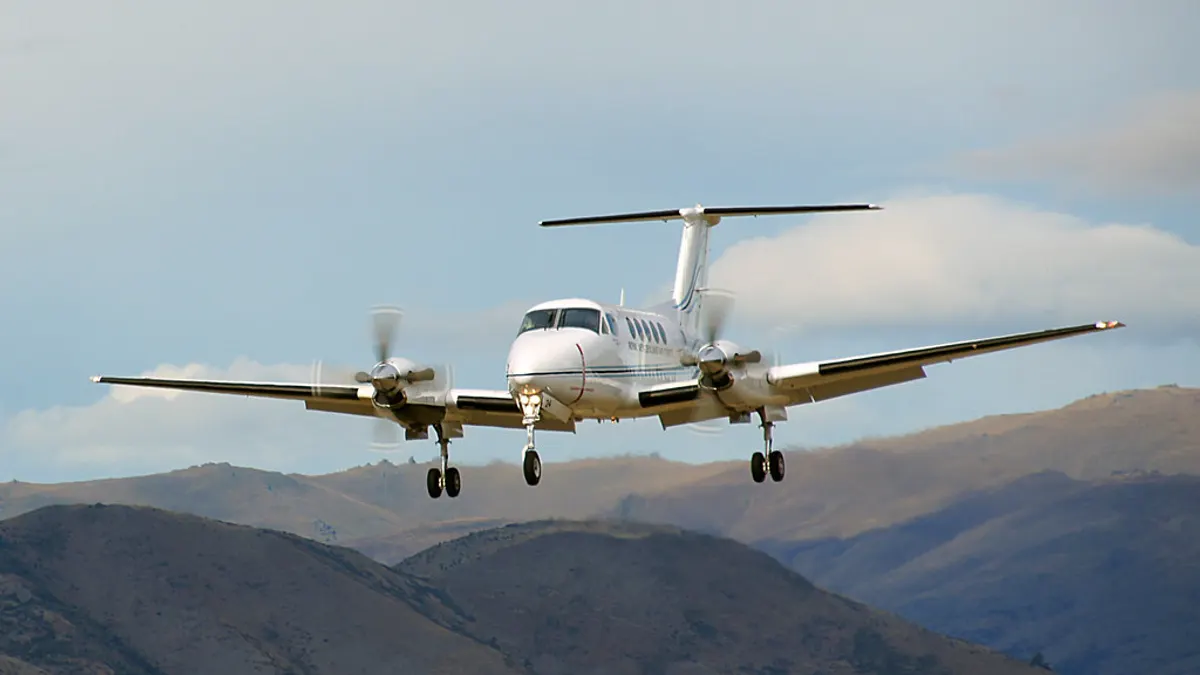
A turboprop is usually the better value for short trips of up to about 300 to 400 nautical miles. It charters for roughly half the hourly rate of a light jet and can use shorter runways, while costing only a few extra minutes in the air. On longer trips, a light jet's higher speed saves real time, and the cost difference narrows.
Key takeaways
- Turboprops cost less per hour, about $2,000 to $3,400 against $4,000 to $5,900 for light jets in our tools' data.
- Light jets are about 50% faster, cruising near 440 knots against about 290 for turboprops.
- On short trips the time difference is small: about 11 minutes on 150 nm, growing to over an hour on 900 nm.
- Turboprops reach more airports, including short and some unpaved runways.
- Light jets fly higher, above more of the weather, with more speed for longer trips.
What is the difference between a turboprop and a light jet?
Both are powered by turbine engines, but a turboprop's engine turns a propeller while a jet's produces thrust directly. That difference shapes speed, altitude, runway needs and cost.
| Turboprops | Light jets | |
|---|---|---|
| Typical cruise | About 290 knots | About 440 knots |
| Typical hourly rate | $2,000–$3,400 | $4,000–$5,900 |
| Typical seats | 6–9 | 6–8 |
| Typical range | 1,100–1,800 nm | 1,500–2,200 nm |
| Certified ceiling | About 30,000–35,000 ft | About 45,000–51,000 ft |
| Runways | Short, and some unpaved strips | Longer, paved runways |
| Examples | Pilatus PC-12, King Air 350i | Phenom 300E, Citation CJ4 |
Figures are typical ranges from the aircraft data behind our tools, which uses rounded manufacturer specifications. Individual aircraft vary.
Manufacturers publish the detail. Pilatus lists the PC-12 PRO at a maximum cruise speed of 290 knots, a maximum range of 1,765 nm and a takeoff distance of 2,485 feet. Cessna lists the Citation CJ4 Gen3 at a maximum cruise speed of 451 knots, a maximum range of 2,165 nm and a takeoff field length of 3,410 feet.
How much does a turboprop save compared with a light jet?
On short trips, a turboprop typically costs a third to a half less. Estimated totals for a same-day round trip with four passengers, using the same method as our charter flight cost calculator, including landing fees, US federal excise tax and segment fees:
| One-way distance | Turboprop | Light jet | Time difference each way |
|---|---|---|---|
| 150 nm | $4,900–$8,600 | $9,500–$14,700 | About 11 min |
| 250 nm | $5,800–$10,200 | $9,500–$14,700 | About 18 min |
| 400 nm | $8,100–$14,100 | $11,700–$17,900 | About 30 min |
| 600 nm | $11,200–$19,400 | $15,800–$24,000 | About 45 min |
| 900 nm | $15,900–$27,400 | $22,000–$33,100 | About 1 h 07 min |
Two things stand out:
- Daily minimums favor turboprops on short hops. Many operators bill at least two hours per day. On a 150 or 250 nm round trip, the light jet's flying time falls below that minimum, so you pay for two jet hours either way, while the cheaper turboprop hour makes the minimum cost much less.
- The gap narrows with distance. Because the turboprop flies longer for the same trip, its lower hourly rate buys less saving as trips get longer.
These are planning estimates, not quotes. Real prices depend on the aircraft, the operator, positioning, season and availability. One-way trips usually also pay for the empty return; see one-way private jet charter.
How much time does a light jet save?
Little on short trips, and more on longer ones. Estimated still-air flight times, including about 18 minutes for taxi, climb and descent:
| Distance | Turboprop | Light jet |
|---|---|---|
| 150 nm | 51 min | 40 min |
| 250 nm | 1 h 12 min | 54 min |
| 400 nm | 1 h 45 min | 1 h 15 min |
| 600 nm | 2 h 29 min | 1 h 44 min |
| 900 nm | 3 h 34 min | 2 h 27 min |
On a trip under an hour, the difference is often less than the time you save by using an airport closer to home. For more on cruise speeds by class, see how fast private jets fly.
What about very light jets?
Very light jets sit between the two. In our tools' data, very light jets such as the Phenom 100 and HondaJet cruise at about 390 knots and charter for about $3,000 to $4,300 per flight hour, with four to six seats. Estimated same-day round trips for four passengers, on the same basis as the table above:
| One-way distance | Very light jet | Flight time each way |
|---|---|---|
| 150 nm | $7,100–$10,800 | 42 min |
| 250 nm | $7,100–$10,800 | 58 min |
| 400 nm | $9,600–$14,300 | 1 h 23 min |
| 600 nm | $13,100–$19,300 | 1 h 55 min |
A very light jet makes sense for a small group that wants jet speed and altitude at a lower price than a light jet. The trade-offs are a seated cabin without stand-up headroom, limited baggage space and a shorter range. With six or more passengers or bulky bags, a turboprop such as the PC-12 or King Air often has more usable room.
Does the comparison change for one-way trips?
Not much, but both options cost more per occupied hour. Most operators bill one-way trips with the empty return, unless the aircraft has an onward booking. On our estimator's basis, a one-way 250 nm trip for four comes to about $4,400–$9,500 by turboprop and $7,500–$13,700 by light jet. At 600 nm, it is about $8,800–$18,800 against $12,400–$23,000.
The best way to cut a one-way price is to find an aircraft already positioned for your route. Ask about empty legs, which can be much cheaper when the dates fit.
Runways and airports: where turboprops shine
A turboprop can often land closer to where you are going. Pilatus says the PC-12 can operate at airports with short runways or unmade grass, gravel or snow runways. Most light jets need longer, paved runways, and operators add safety margins for wet runways, hot days and high-altitude airports.
That opens options such as:
- Small island airports in the Bahamas and the Caribbean; see private jets to the Caribbean.
- Ranch and lake airstrips, where the runway is short or unpaved.
- Small regional airports closer to a meeting or a vacation home.
Whether a specific airport works depends on the runway, the aircraft, the weather and the load. The operator makes that call for every flight.
Comfort, weather and cabin
Light jets usually offer a quieter, smoother ride, but turboprop cabins can be roomy.
- Altitude and weather. Light jets are certified to fly higher, above more weather and turbulence. Turboprops typically fly lower, so on stormy days the ride can be bumpier and routing may change more.
- Noise. Modern turboprops are well insulated, but propellers make more cabin noise and vibration than jet engines mounted at the rear.
- Cabin space. The PC-12 and King Air have cabins similar in height to many light jets, and Pilatus describes the PC-12 PRO's cargo door as "huge," which makes bulky items easier to load.
- Lavatory. Many turboprops have no enclosed lavatory, while many light jets do. On longer trips, ask about the specific aircraft.
Which should you choose?
Pick the turboprop when:
- The trip is short, under about 300 to 400 nm.
- You want to use a short or unpaved runway.
- You are carrying bulky gear, such as skis or golf bags, and the aircraft has a large cargo door.
- Cost matters more than 15 to 30 minutes of flight time.
Pick the light jet when:
- The trip is longer than about 400 nm, or time is tight.
- Weather en route is likely to be poor.
- You want a quieter cabin and an enclosed lavatory.
- The route needs more range or speed for a nonstop flight; see how far a private jet can fly.
For trips that need more room or range, see light vs midsize vs heavy jets.
Are turboprops as safe as jets?
Safety comes from the operator, not the engine type. Turboprops chartered in the US are flown under the same FAA Part 135 rules as jets, by certificated operators with trained, checked crews. Modern turboprops have turbine engines, pressurized cabins and advanced avionics.
What matters is who operates the flight. Before you book any aircraft, check the operator using our guide to verifying a Part 135 charter operator.
Getting quotes for both
If your trip is short or uses a small airport, ask for quotes on both a turboprop and a light jet. You can compare the price and the time difference side by side before you decide. Request a quote with your route, dates and group size, and we will price both classes with the operators who can fly your trip.