

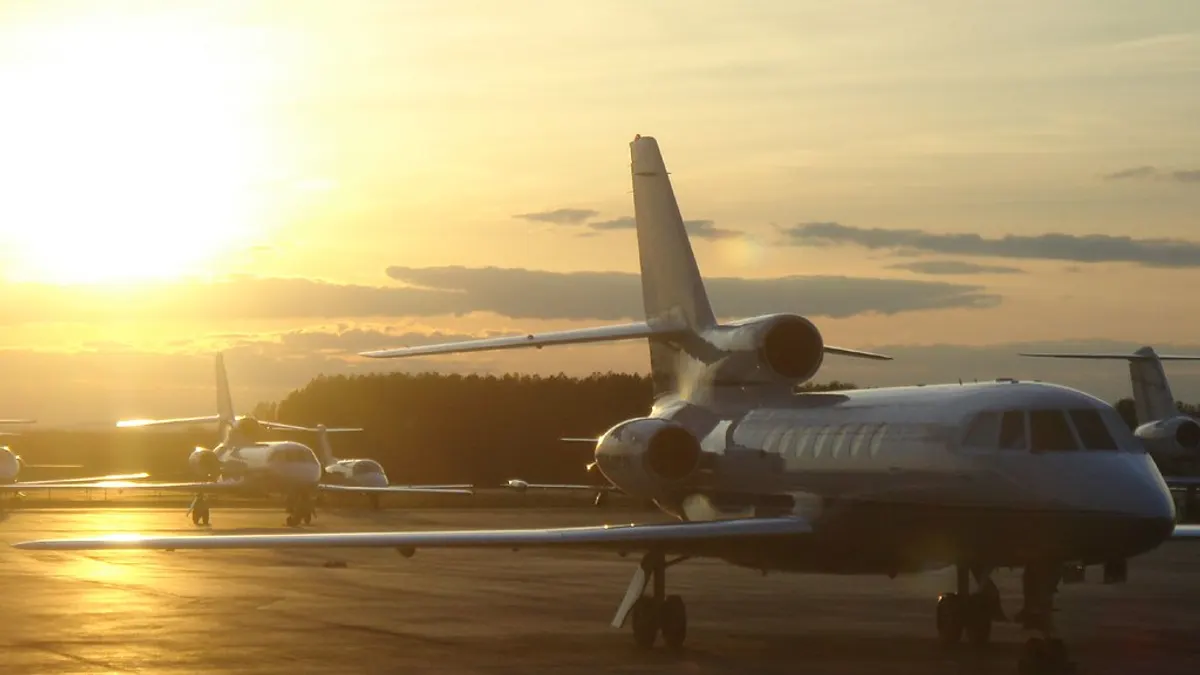
An FBO (fixed-base operator) is the private terminal used by charter and business aircraft at an airport. It is a business that sells fuel, parking, hangar space and passenger handling, and for passengers it replaces the airline terminal: you drive up, meet your crew in a lounge, and walk or ride to the aircraft, usually within minutes of arriving.
Key takeaways
- The FBO is where your charter departs and arrives. There is no airline check-in or TSA checkpoint on most private flights.
- Arrive 15 to 30 minutes before a domestic departure unless your operator says otherwise; allow more time for international trips.
- Many FBOs allow ramp-side car access, but it depends on airport security rules and must be arranged in advance.
- FBO handling, ramp and parking fees are usually built into the charter quote as pass-through costs.
- Large chains such as Signature Aviation, Atlantic Aviation, Jet Aviation and Million Air run many FBOs, but plenty of the best are independent.
What is an FBO?
An FBO is a company an airport authorizes to provide aeronautical services to the public. The FAA's advisory circular on airport minimum standards defines a fixed-base operator as a commercial business granted the right by the airport sponsor to provide services such as fueling, hangaring, tie-down and parking, aircraft rental, maintenance and flight instruction.
In practice, an FBO is typically a building facing the ramp with a lobby, lounges and a front desk, plus a fuel farm, hangars and line staff who park, fuel and tow aircraft.
Charter passengers rarely choose the FBO themselves. The operator or broker picks one based on fuel price, handling quality, customs access and where the aircraft can park, then sends you the address and arrival instructions.
What services does an FBO offer passengers?
For passengers, an FBO is a small, quiet terminal with a direct path to the aircraft. Facilities vary from a single room at a regional airport to multi-level lounges at busy business aviation airports, but you can usually expect:
- A lobby and passenger lounge with seating, Wi-Fi, coffee and restrooms. Larger FBOs add conference rooms, quiet rooms and showers.
- A front desk that greets you, confirms your flight and tells the crew you have arrived.
- Ramp access: the doors from the lounge lead directly onto the apron where the aircraft parks.
- Baggage handling: line staff take your bags from your car or the lobby to the aircraft.
- Concierge help: arranging cars, hotels and restaurant bookings at the destination.
- Catering coordination: the operator usually orders catering, and the FBO receives and stores it until loading.
For the crew and aircraft, the FBO provides fuel, ground power, de-icing, hangar space, lavatory and water service, a pilot lounge and often a flight planning room. These are what make an FBO work, even if passengers never see them.
What are the major FBO chains?
Two private equity-backed networks dominate in the US: Signature Aviation and Atlantic Aviation. Several smaller chains and many independent FBOs compete with them. Network sizes as stated on each company's website in October 2026:
| FBO network | Locations (company figure) | Coverage |
|---|---|---|
| Signature Aviation | More than 200 | 27 countries on 5 continents |
| Atlantic Aviation | More than 105 | North America |
| Jet Aviation | 45 | Americas, Europe, Middle East, Asia Pacific |
| Million Air | 36 | Mostly in the US |
Smaller regional groups include Sheltair (mainly Florida and the Southeast) and Modern Aviation (New York area and other US airports), and Clay Lacy Aviation runs a well-known FBO at Van Nuys. Hundreds more FBOs are independent. Business Jet Traveler's 2026 FBO survey notes that the two largest chains face growing competition from smaller chains and new entrants. A chain name tells you something about consistency, but local staff matter more; some of the most highly rated FBOs are single-site independents.
Many busy airports have more than one FBO. At Teterboro, Van Nuys or Palm Beach, for example, several compete side by side, and your operator will tell you which building to go to. Our guide to the top private jet airports in the United States covers the main business aviation airports.
How early should you arrive at an FBO?
For a domestic charter, arriving 15 to 30 minutes before departure is typical. There is no airline check-in, no bag drop deadline and, on most charters, no security line, so the main job on arrival is a quick ID check and loading the bags.
Allow more time when:
- The flight is international. The crew needs to check passports and, for some destinations, visas or pet paperwork before departure.
- You have a large group or lots of luggage. Loading golf bags, skis or many cases takes longer and may need repacking into the hold.
- The airport is congested. At peak times at busy airports, traffic on the access roads is often the biggest delay.
- You are travelling with pets or need assistance. See our guide to flying private with pets.
Always follow the arrival time your operator gives you. Crews plan engine start and departure slots around it, and arriving late can mean losing a slot at busy airports.
Can your car drive onto the ramp?
At many FBOs, a car can be escorted to the aircraft, but it is never automatic. Whether vehicles can drive airside depends on the airport's security rules, the FBO's policy and how busy the ramp is.
Where it is allowed, the usual process is:
- Ask your advisor or the operator at booking, so the request reaches the FBO before the day.
- Provide the driver's full name, the vehicle make, color and plate number, and sometimes a driver's license copy.
- On arrival, the driver checks in at the FBO gate or desk and is escorted by line staff to the aircraft.
- Bags go straight from the car into the hold, and the car leaves the ramp before engine start.
At busy or tightly secured airports, the FBO may instead have you park at the front, walk through the lobby and be driven to the aircraft in an FBO vehicle. Either way, the walk is short. If ramp access matters for privacy or mobility, tell us when you request a quote so it can be confirmed in writing.
Do you go through security or customs at an FBO?
Most charter passengers do not pass through a TSA checkpoint. Operators flying business jets for hire follow TSA security programs such as the Twelve-Five Standard Security Program, which, as NBAA explains, focuses on crew background checks and flight deck access rather than airline-style passenger screening. The crew will still check government ID against the manifest, and you should not carry anything you could not legally carry on an airline.
International arrivals are different. Private flights entering the US must clear U.S. Customs and Border Protection at an approved airport of entry, and the operator must send passenger details through CBP's electronic manifest system no later than 60 minutes before departure, according to the CBP Private Air APIS Guide. That is why your advisor will ask for passport details well ahead of the trip.
At some airports, CBP officers inspect passengers at a facility inside or next to an FBO; at others, the aircraft taxis to a separate customs building first. The experience is usually much faster than an airline arrival hall. Your operator chooses the first US landing airport partly on where customs is available at your arrival time.
How do FBO fees appear on a charter quote?
FBO charges are usually included in the charter quote as pass-through costs, so you rarely pay the FBO directly. The operator settles the FBO's invoice and adds it to yours. Typical items include:
| Fee | What it covers | How it usually appears |
|---|---|---|
| Handling or facility fee | Use of the FBO terminal and line services | Included or listed as "FBO/handling" |
| Ramp or parking fee | Parking the aircraft on the apron | Often reduced or waived when the aircraft buys fuel |
| Overnight or hangar fee | Overnight parking or hangar space in bad weather | Added on multi-day trips |
| Landing fee | Charged by the airport, sometimes collected by the FBO | Listed with airport fees |
| Catering, de-icing, ground transport | Ordered for your trip | Billed at cost, often after the trip |
These fees vary widely by airport and FBO, from modest at quiet regional fields to substantial at the busiest business aviation airports, and they can change with fuel purchases. Ask whether your quote is "all-in" or whether some items, such as de-icing and catering, will be billed afterward. Our private jet charter cost guide explains the full structure, the charter flight cost estimator includes handling fees per leg, and the charter tax calculator shows how federal excise tax and segment fees are added.
What to expect at an FBO, step by step
- Before the day. You receive the FBO name, address and arrival time, the tail number or crew names, and any car access arrangements.
- Arrival. Pull up at the front or the ramp gate. Line staff collect your bags.
- Check-in. Give your name at the front desk and show government ID. The desk tells the crew you are there.
- Meet the crew. The captain or first officer greets you, confirms passengers and bags, and briefs you on weather and flight time.
- Board. Walk out, or be driven, to the aircraft. Departure usually follows within minutes once everyone is on board.
- Arrival at the destination. The aircraft parks outside the destination FBO, where your car can often meet you at the aircraft or at the front door. Bags come off with you.
Practical tips
- Save the FBO's phone number. If you are running late, call the FBO desk and your advisor; they will pass the message to the crew.
- Bring the same ID as on the manifest. Names must match for international flights.
- Mention special requirements early. Wheelchair assistance, car seats, oversized items and pets all need advance notice.
- Do not assume the airport. Many cities have several business aviation airports, and the closest FBO to your home may not be the one the operator chose.
Choosing the right aircraft matters as much as choosing the right terminal; our guide to private jet sizes helps with that. To see how long your trip will take from FBO to FBO, try the flight time calculator, or request a quote and an advisor will confirm the FBO, arrival time and car access with the operator.