

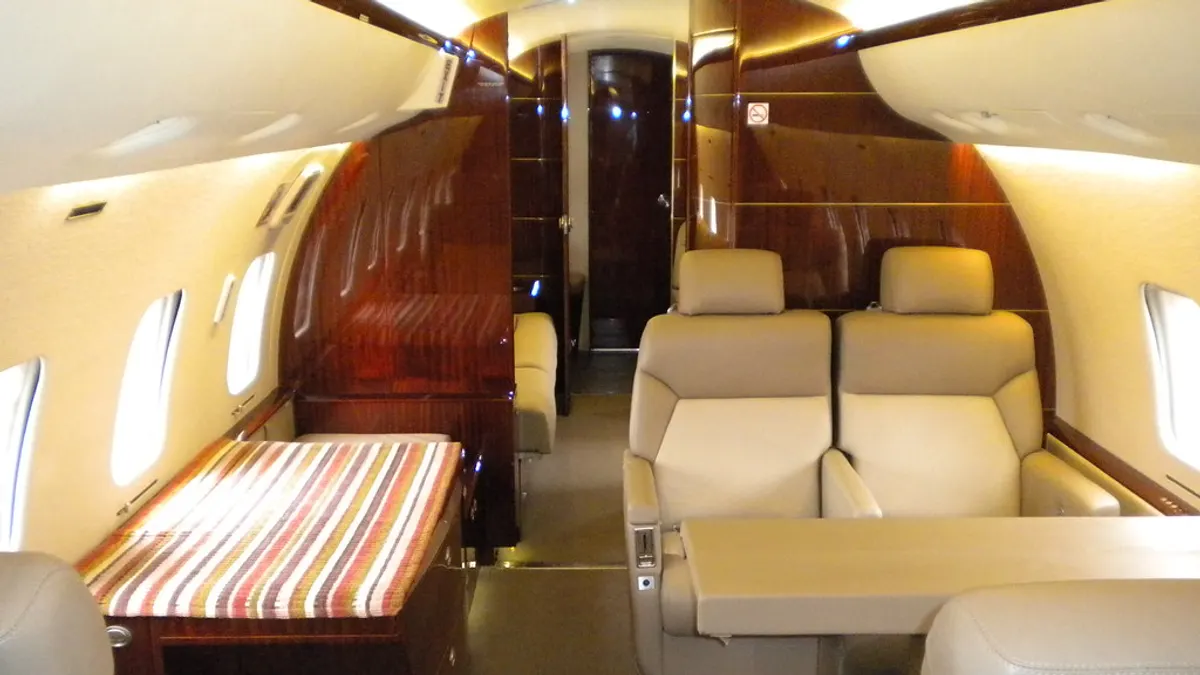
Flying private with kids is allowed at any age, and the main rules are about restraints. FAA charter rules let a child under two sit on an adult's lap, and allow car seats labeled for aircraft use if they are secured to a forward-facing seat. Booster seats and harness vests are not approved for takeoff and landing, except FAA-approved devices such as the CARES harness.
Key takeaways
- Lap infants are allowed for children under two, but the FAA's guidance is that an approved car seat is safer.
- Bring an aircraft-approved car seat with the right label, and confirm the aircraft has a forward-facing seat for it.
- Booster seats and vests cannot be used for takeoff, landing or taxiing.
- Choose the aircraft for the family, not just the route: cabin size, lavatory and baggage space matter more with children.
- Tell the broker everything about the children's ages, gear and needs when you request quotes.
Can you fly a private jet with a baby or young child?
Yes, at any age. Private charter is often easier with young children than flying commercial. There are no security lines, the departure waits for you, the family sits together and the cabin is yours. If a baby cries, there is no one else to disturb.
The rules that matter are the FAA's charter rules on seats and restraints, which apply to every Part 135 flight. Under 14 CFR 135.128, everyone on board must be in an approved seat with a safety belt fastened during taxiing, takeoff and landing, with two exceptions for children: a child under two may be held on an adult's lap, or any child may use an approved child restraint system.
Car seats on private jets: what the FAA requires
A car seat can be used on a charter flight if it is approved for aircraft use and secured properly. The rule sets out three conditions.
- The right label. Seats made to US standards since February 26, 1985, must carry two labels, including one in red lettering that reads "THIS RESTRAINT IS CERTIFIED FOR USE IN MOTOR VEHICLES AND AIRCRAFT." Seats approved by a foreign government or built to United Nations standards, and certain FAA-approved devices, are also accepted with the right markings.
- A forward-facing seat. The restraint must be secured to an approved forward-facing seat or berth.
- A responsible adult. The child must be accompanied by a parent, guardian or designated attendant, and must not exceed the restraint's weight limit.
The rule also says an operator may not stop a parent from using an approved car seat for a child who has a seat, though the operator can decide the most appropriate seat location for it.
Why the forward-facing rule matters on a private jet
Business jet cabins are often arranged as club seats facing each other, plus a side-facing divan on many larger jets. Only the forward-facing seats can take a car seat, so ask the broker which seats on your aircraft face forward and how many there are. If you are traveling with two or three young children in car seats, this can decide which aircraft works.
Lap infants: is it allowed and is it safe?
It is allowed for children under two, but a car seat is the safer choice. Under 135.128, a child who has not reached their second birthday may be held by an adult in an approved seat, without a restraint of their own. The FAA's guidance for families is that the safest place for a child under two is an approved child restraint system, not an adult's lap, because turbulence can be sudden.
Lap infants still count as passengers. Include them in the passenger list you give the operator, and in the total when you compare aircraft.
Booster seats, harnesses and other devices
Booster seats, vest or harness-type restraints and lap-held restraints are not approved for aircraft use during taxiing, takeoff and landing, according to 135.128. The exception is a device the FAA has approved specifically for aircraft. The rule names one: the AmSafe CARES harness, which attaches to the aircraft seat.
Practical tips:
- Bring the booster as baggage if you need it for the car at your destination.
- Check the label before you leave home, not at the aircraft.
- Practice installing the car seat with a lap belt only, which is how it will be secured on board.
- Bring the manual in case the crew wants to check the installation.
Which private jet is best for families?
For families, cabin and comfort matter as much as range. A few points to weigh:
| Need | What to look for | Classes to consider |
|---|---|---|
| Short trip, small family | Enough forward-facing seats for any car seats | Light jets, turboprops |
| Two to four hours with toddlers | Room to move, an enclosed lavatory | Midsize jets, super midsize jets |
| Long trips or overnight flights | Divans or seats that make beds, a full galley | Heavy jets and larger |
| Lots of gear | A large baggage hold, ideally accessible in flight | Midsize jets and larger |
Smaller jets have tighter cabins and smaller lavatories, which matters on longer trips with young children. Ask about stand-up cabin height, lavatory type and whether the baggage hold can be reached during the flight, so you can get to spare clothes and supplies.
Typical US charter rates run about $4,000 to $5,900 per flight hour for a light jet and $5,000 to $7,200 for a midsize jet, before taxes and fees. Use our private jet charter cost calculator to compare classes for your route.
Packing for a private flight with kids
You can bring more than on an airline, but space is not unlimited. Strollers, car seats and travel cots all take room in the hold, and smaller jets fill up quickly. Tell the broker exactly what you plan to bring; our guide to private jet baggage limits explains how space is checked.
A packing list for the cabin:
- Changes of clothes for each child, and a spare top for the adults.
- Diapers, wipes and bags, more than you think you need.
- Formula, milk and baby food. With no TSA checkpoint at most private terminals, the airline liquids limit does not apply in the same way, but keep anything you need on board within reach.
- Medication, in its original packaging.
- Headphones, tablets and chargers, downloaded before departure in case Wi-Fi is limited; see private jet Wi-Fi.
- Comfort items, such as a blanket or favorite toy.
Spare lithium batteries and power banks must travel in the cabin, not the hold.
Food, sleep and comfort on board
Plan the flight around the children's routine where you can.
- Order child-friendly food. Simple, familiar food works best, and the operator can arrange it with the catering; see our private jet catering guide. Bring milk and snacks you know they will eat.
- Help with ear pressure. Feeding a baby or giving older children a drink or snack during descent can help with ear discomfort.
- Time departures well. A flight that overlaps a nap or bedtime is often calmer.
- Keep belts on when seated. Turbulence can be unexpected, so children should stay belted whenever they are in their seats.
- Listen to the briefing together. Under 14 CFR 135.117, the pilot must brief passengers before each takeoff, including on seat belts and emergency exits. Older children like to know where the exits are.
Does flying private make sense for a family?
The arithmetic changes when the whole family travels. A charter is priced per aircraft, not per seat, so the cost is spread across everyone on board. Four or five people flying together on a light jet divide the same total that one or two would pay alone, which is why families often find charter closer to premium cabin fares than they expect.
Things that tip the balance for families:
- Group size. The more seats you use, the better the per-person comparison.
- Airports. A smaller airport nearer home can save a long drive with tired children.
- Awkward routes. Trips that need a connection commercially often become a short nonstop.
- Gear. Car seats, strollers and sports equipment travel without airline baggage rules.
Compare the real numbers before deciding. Our charter flight cost estimator prices the trip by class, and our guide to saving money on charter covers one-way pricing and flexible dates.
Documents and paperwork for children
Bring proof of identity for every child. Within the US, a passport or birth certificate copy covers you if the operator asks. For international trips, every child needs their own passport, and if one parent is traveling alone with a child, consider carrying a signed consent letter from the other parent. Our guide to what ID you need to fly private covers the details, and TSA and private jets explains when screening applies.
If the family pet is coming too, see flying private with pets.
Tips for a smooth family trip
- Share ages, weights and gear when you request quotes, so the broker can match the aircraft.
- Ask which seats face forward and how many car seats the aircraft can take.
- Check car seat labels before you leave home.
- Pack the cabin bag with everything for the flight plus a delay.
- Arrive a little early so children can settle in before departure.
- Consider an empty leg if your dates are flexible, which can lower the cost of a family trip.
Planning a family charter
Tell us the number of children, their ages and the gear you are bringing when you request a quote. We will check the aircraft's seating, baggage space and lavatory with the operator before you book, so the trip suits the whole family.