

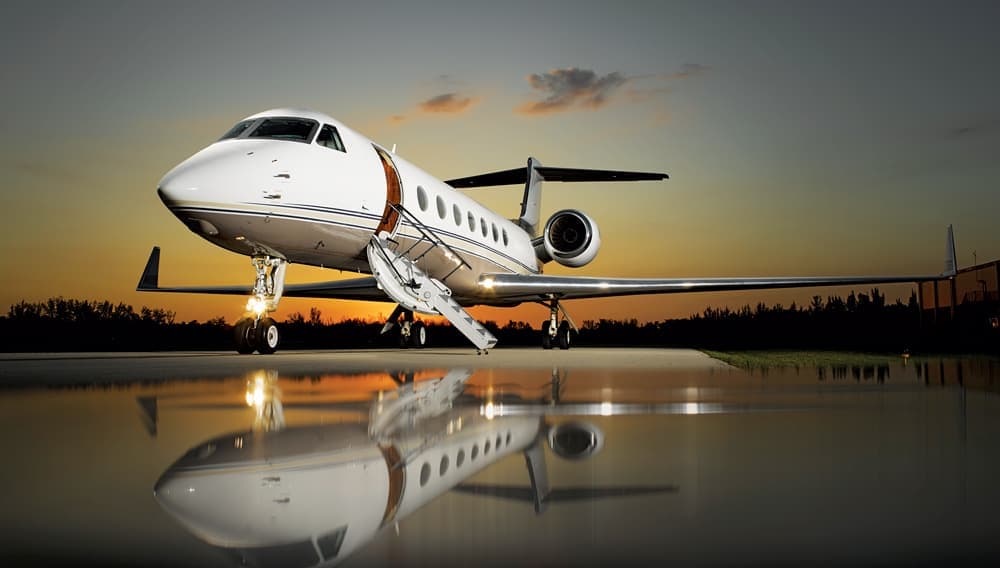
The top private jet airports in the United States by business aircraft departures in 2025 were Teterboro (New York area), Dallas Love Field, Westchester County, Palm Beach and Washington Dulles, according to ARGUS TRAQPak data. Teterboro led by a wide margin, with 75,029 departures. For any single trip, though, the best airport is the one with the right facilities closest to where you are going.
Key takeaways
- Teterboro is the busiest private jet airport in the US, with almost twice the departures of any other airport in 2025.
- New York has two airports in the top three: Teterboro and Westchester County (White Plains).
- Several busy airline airports, such as Dallas Love Field, Palm Beach, Dulles and Las Vegas, are also among the busiest for private jets because of their large FBOs.
- Van Nuys fell from fifth to ninth in 2025 but remains the main private jet airport for Los Angeles.
- Busiest is not always best: runway length, customs, curfews and ground transfer time matter more for a given trip.
The airport choice rarely changes the price much; the aircraft and flight time do. For a typical range on your route, try the private jet charter cost estimator.
What are the busiest private jet airports in the US?
Teterboro, Dallas Love Field, Westchester, Palm Beach and Washington Dulles were the five busiest US airports for business aircraft departures in 2025. The ranking below comes from ARGUS TRAQPak flight tracking data, as published in 2025's busiest US private jet airports. Runway lengths are from FAA airport data on AirNav.
| Rank | Airport | Serves | 2025 departures | Change vs 2024 | Longest runway |
|---|---|---|---|---|---|
| 1 | Teterboro (TEB) | New York City | 75,029 | +0.3% | 6,997 ft |
| 2 | Dallas Love Field (DAL) | Dallas | 41,379 | +2.6% | 8,800 ft |
| 3 | Westchester County (HPN) | Westchester, Connecticut | 36,921 | +11.9% | 6,549 ft |
| 4 | Palm Beach (DJT, formerly PBI) | Palm Beach | 34,274 | -18.3% | 10,001 ft |
| 5 | Washington Dulles (IAD) | Washington, DC | 33,504 | +11.4% | 11,500 ft |
| 6 | Las Vegas Harry Reid (LAS) | Las Vegas | 30,939 | -2.6% | 14,835 ft |
| 7 | Miami-Opa Locka Executive (OPF) | Miami | 30,207 | +3.9% | 8,002 ft |
| 8 | Scottsdale (SDL) | Scottsdale, Phoenix | 28,681 | +2.3% | 8,249 ft |
| 9 | Van Nuys (VNY) | Los Angeles | 28,263 | -12.3% | 8,001 ft |
| 10 | Houston Hobby (HOU) | Houston | 28,154 | -0.3% | 7,602 ft |
Just outside the top ten were Centennial (APA) near Denver, DeKalb-Peachtree (PDK) in Atlanta, Naples (APF) and John Wayne (SNA) in Orange County. Departures count flights by business aircraft tracked by ARGUS, so they measure private and business flying rather than total airport traffic, which for airline airports is far higher.
Two patterns stand out. First, New York dominates: Teterboro recorded nearly as many departures as Dallas Love Field and Westchester combined, and Westchester grew faster than any other top-five airport. Second, Palm Beach and Van Nuys both fell sharply in 2025, while Dulles and Fort Lauderdale International grew quickly.
What makes an airport good for private jets?
A good private jet airport has strong FBOs, enough runway for the aircraft, customs if you are flying internationally, little airline congestion and a short drive to where you are going. Few airports score top marks on all five, which is why most big cities have more than one option.
- FBOs. The fixed base operator is your terminal: lounge, cars to the aircraft, fuel and handling. Busy airports usually have several competing FBOs.
- Runway length. Most light and midsize jets are comfortable on 5,000 to 6,000 feet. Heavy and ultra long range jets flying long distances at full fuel need more, especially on hot days or at high elevation.
- Customs. For an international arrival, the airport needs US Customs and Border Protection. Some have CBP on the field; others are CBP user-fee airports, where the airport pays for the service and hours are limited, so the operator books ahead.
- Local rules. Weight limits, noise limits and voluntary curfews can rule out certain aircraft or departure times.
- Ground time. A slightly farther airport with an easy drive often beats a closer one behind a bridge or tunnel at rush hour.
New York: Teterboro and Westchester
Teterboro is the default for Manhattan, and Westchester for Westchester County and Connecticut. Teterboro, in New Jersey about 8 miles from Midtown in a straight line, is owned by the Port Authority of New York and New Jersey and has no scheduled airline service. It limits aircraft to an actual weight of 100,000 lb, which affects only the largest long-range jets.
Westchester County Airport (HPN) near White Plains grew 11.9% in 2025 to take third place nationally. It asks operators to avoid flying between midnight and 6:30 a.m. under a voluntary program. Republic (FRG) on Long Island, Morristown (MMU) in New Jersey and Stewart (SWF) in the Hudson Valley complete the picture.
Our full guide to New York private jet airports compares all five, with distances and customs details, and our overview of private aviation hubs in the Northeast covers Boston, Washington and the summer islands.
Los Angeles: Van Nuys and the alternatives
Van Nuys (VNY) is the main private jet airport for Los Angeles, even after falling to ninth nationally in 2025. It has no airline service, an 8,001-foot main runway, several FBOs and US Customs as a CBP user-fee airport, so international flights can arrive directly.
Alternatives depend on where you are going:
- Hollywood Burbank (BUR) for Hollywood, Studio City and Pasadena.
- John Wayne (SNA) for Orange County, also a CBP user-fee airport.
- LAX for airline connections and international arrivals.
- Santa Monica (SMO) only for small aircraft, and not for long: its runway was shortened in 2017 and the airport is set to close at the end of 2028.
See our Los Angeles private jet airports guide for runway, fee and customs details.
Florida: Palm Beach, Miami and Fort Lauderdale
South Florida has four of the 25 busiest US private jet airports, led by Palm Beach and Miami-Opa Locka Executive. Palm Beach International was renamed President Donald J. Trump International Airport in July 2026, and its FAA identifier changed from PBI to DJT, as AirlineGeeks reported. Its 10,001-foot runway handles any business jet, and it is the gateway to Palm Beach's winter season.
For Miami, Opa Locka Executive (OPF) ranked seventh in 2025 and keeps private flights away from Miami International's airline traffic. Fort Lauderdale Executive (FXE) and Boca Raton (BCT) are popular too, and Boca Raton is a CBP user-fee airport. Fort Lauderdale International (FLL) grew 17.6% in 2025. Our guide to private jet charter to Miami covers the Miami options and the busiest weeks, such as Art Basel in December.
Texas, the West and other top airports
Dallas Love Field is the second-busiest private jet airport in the US, and Scottsdale, Las Vegas, Houston Hobby and Centennial round out the leaders outside the coasts.
- Dallas Love Field (DAL), close to downtown Dallas and Highland Park, has an 8,800-foot runway and large FBOs alongside its airline traffic. It is a CBP user-fee airport. Addison (ADS), with a 7,203-foot runway, is a popular alternative for north Dallas and is also a user-fee customs airport.
- Scottsdale (SDL) rose from eleventh to eighth in 2025. Its runway is 8,249 feet long but only 100 feet wide, and it has user-fee customs.
- Centennial (APA) south of Denver has a 10,001-foot runway, useful at an elevation of almost 5,900 feet, where jets need more runway to take off.
- Washington Dulles (IAD) and Las Vegas (LAS) are large airline airports with long runways and big FBO complexes, which is why they appear in the top ten.
- Chicago splits its traffic between Midway (MDW) and Chicago Executive (PWK), both in the top 25.
- Aspen (ASE) is not among the busiest by volume, but it is one of the most demanding: an 8,006 x 100-foot runway at high elevation, with aircraft restrictions. See our Aspen guide.
Is it better to fly into a big airline hub or a business aviation airport?
For most charter trips, a business aviation airport is better: less taxi time, quieter FBOs and often a shorter drive. Airline hubs such as JFK, LAX or Chicago O'Hare accept private jets, but private flights share runways with airline traffic and can wait longer for departure.
A hub makes sense when you are connecting to an airline flight, when you need a very long runway for a heavy aircraft at full fuel, or when it is simply closest to your destination. The top-ten list shows that some airline airports, including Dulles and Las Vegas, work well for private flights because they have large, separate FBO areas.
How do you choose the right airport for a private flight?
Start with where you are going, then check the aircraft, customs and timing. A short checklist to run with your operator or charter advisor:
- Final destination. Compare drive times at your actual travel time, not straight-line distance.
- Aircraft size and fuel. Ask whether runway length, elevation, heat or a weight limit could reduce the fuel load and force a stop.
- Customs. For an international arrival, confirm CBP is available at your arrival time and, at user-fee airports, that the slot is booked.
- Curfews and noise rules. Late-night departures may not be possible, or welcome, at some airports.
- FBO and fees. Ask which FBO the operator uses and whether landing, handling and parking fees are included in the quote.
- Flight time. The flight time calculator estimates block time between airports, and the range explorer shows which aircraft can fly the route nonstop.
Does the airport change the cost of a private jet?
Only at the margins. The biggest factors are the aircraft class and the flight time. Typical US on-demand rates per flight hour, before taxes and fees, are $4,000–5,900 for a light jet, $5,000–7,200 for a midsize jet, $6,500–9,800 for a super midsize jet and $8,500–13,000 for a heavy jet. Quotes vary with season, availability and positioning.
Airports add landing fees, FBO handling and overnight parking, and the busiest ones can be expensive at peak times. Using an airport where an aircraft is already based can also save positioning time. Ask about empty legs at the busy airports above, where repositioning flights are most common.
Find the right airport for your trip
The busiest airports are busy for a reason: good FBOs, convenient locations and the runways to match. But the right one for you depends on your destination, aircraft and timing. Tell us where and when you are flying and request a quote, and we will suggest the airport, FBO and aircraft that fit the trip.