

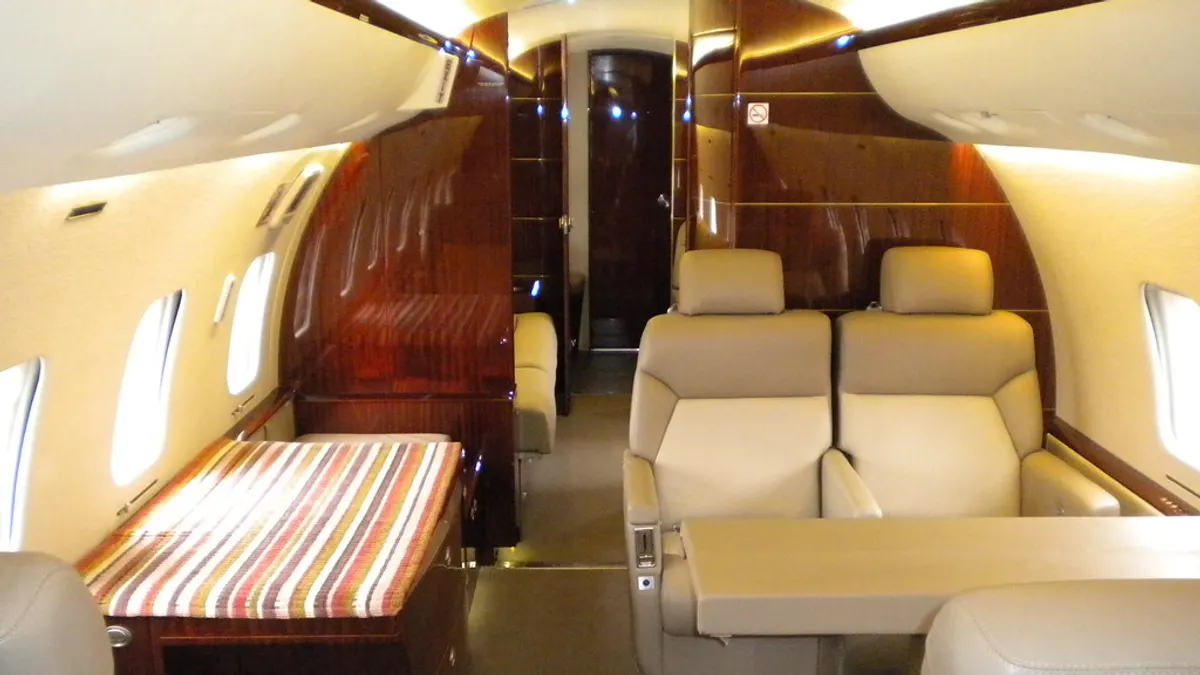
An empty leg flight is a private jet flight that would otherwise fly with no passengers, usually because the aircraft is returning to base after a one-way charter or positioning for its next booking. Operators sell these flights below normal charter prices. You get the whole aircraft for less, but the route and timing are fixed and can change.
Key takeaways
- Empty legs exist because one-way charters leave aircraft out of position. The flight happens with or without you.
- Savings vary widely. Marketing claims run to 50% to 80% off; one independent review found 15% to 20% more typical. Compare with a normal one-way quote.
- You buy the whole aircraft, and you still pay federal excise tax and segment fees.
- The flight belongs to someone else's schedule. If the paying trip changes, your empty leg can move or disappear, with no backup aircraft.
- Flexibility and speed win. Alerts, a broker who knows your routes and a short checklist get you the good ones.
What is an empty leg flight?
An empty leg flight is a repositioning flight that a charter aircraft would otherwise fly without passengers, sold by the operator at a discount rather than flown for no revenue. It exists because one-way trips leave aircraft away from base or out of position, and the jet has to make that flight whether or not anyone buys it.
The two most common causes are one-way trips and positioning flights.
One-way trips. A client flies from New York to Aspen and stays a week. The jet usually flies home to New York empty rather than wait. That return is an empty leg.
Positioning flights. A client in Miami books a jet based in Teterboro. The jet flies from Teterboro to Miami empty to collect them. That outbound flight is an empty leg.
Trade press also calls these flights "deadheads." Without paying passengers, they usually fly under the FAA's general operating rules: as Business Jet Traveler explains, aircraft on "empty leg" repositioning flights between charters "may and often do operate under Part 91 rules." Once you buy the flight, it carries paying passengers and must be operated as a commercial charter under Part 135, like any other charter.
Empty legs are not a product designed around you. They are leftovers from someone else's itinerary, and that explains every trade-off below. To see what the same trip costs as a normal booking, start with our private jet cost calculator.
How are empty leg flights priced?
Empty leg flights are priced below normal charter rates because the operator has to fly the aircraft anyway and earns nothing if it flies empty. You buy the whole aircraft, not a seat. Discounts vary: brokers often advertise 50% to 80% off, but one independent review found 15% to 20% more typical. Taxes and fees still apply.
Why they are discounted
On a normal one-way, the client usually pays for the empty return, which is why a one-way can cost close to a round trip (see our guide to one-way private jet charter). When that return or a positioning flight is offered as an empty leg, any price the operator gets is extra revenue on a flight that was going to happen. That is the whole basis of the discount.
What discount is typical?
There is no standard percentage, and headline numbers are the exception:
- Doug Gollan of Private Jet Card Comparisons notes that brokers and operators market empty legs "at 50% to 80% off rack rates."
- A Business Jet Traveler review of empty-leg buying was more cautious: "Typically, though, you can save 15 to 20 percent off regular charter rates, and sometimes more." The same article calls the idea that operators will take any income for an empty leg "a myth."
The discount depends on time to departure, demand on the route and how much the operator needs the revenue. It also applies to that aircraft's normal rate, so a discounted heavy jet can still cost more than a full-price light jet.
Whole-aircraft pricing
You pay for the aircraft, not per seat, so the price is the same for one passenger or eight, up to the seats available. That makes empty legs better value for small groups that split the cost. Some membership programs sell individual seats on empty legs instead; check which you are buying.
Who pays taxes and fees?
The passenger does. In the US, IRS Publication 510 sets a 7.5% tax on "amounts paid for taxable transportation of persons by air," and on a charter the per-passenger domestic segment tax is multiplied by the number of passengers aboard. An empty leg sold to you is taxable transportation like any charter. Our guide to federal excise tax on charter has the current-year amounts. Also ask whether the price includes landing, handling, de-icing and catering, or whether those are added on top.
How to compare an empty leg with a normal quote
The test is simple: what would the same trip cost as a normal one-way on a comparable aircraft? Run it through the calculator set to one-way pricing, which includes the empty return a normal one-way usually bills.
For scale, light jets typically run $4,000–5,900 per flight hour before taxes and fees. A 2-hour one-way that also bills a 2-hour empty return comes to about 4 billed hours, or roughly $16,000–23,600. An empty leg on that route is a good deal only if it beats a normal quote by enough to justify the risk of it moving. Our guide to charter costs in 2026 explains what normal rates include.
How does empty leg availability work?
Empty leg availability depends entirely on operators' schedules. A flight appears when a paying one-way or positioning trip creates an empty repositioning leg, and it disappears when it sells, when the paying trip changes or when the operator fills the aircraft another way. Most appear at short notice on a fixed route and time.
Where they come from
Each empty leg is tied to a specific booking: a drop-off that leaves the jet away from base, a positioning flight to collect a client, or a jet flying from one client's destination to the next client's departure airport. Private Jet Card Comparisons compares that last case to "an Uber driver accepting a new customer while dropping off their current passenger."
How much notice you get
According to Private Jet Card Comparisons, empty legs "can come to market from months to hours before departure, but typically a few days in advance." Business Jet Traveler suggests looking for trips "scheduled for three to 10 days in the future" for the widest choice with the least cancellation risk. Flights further out have more time to change; flights tomorrow give you little time to plan.
Fixed route and time
The aircraft has to be at a set airport by a set time for its paying client. You can sometimes add a nearby airport or shift the departure slightly, often at extra cost, but the route and timing are largely fixed.
Why listings vanish or were never real
Good empty legs on popular routes sell quickly. Others disappear because the paying trip moved. Some were never there: Business Jet Traveler quotes the head of charter data firm ARGUS saying "many of the empty legs posted on these sites are not real empty legs," but lures to start a conversation. The same reporter found one listed flight was actually a Part 91 operation, not legally usable for charter.
What are the risks of booking an empty leg?
The main risk is that the flight changes or disappears, because it depends on a paying trip you do not control. If that trip is cancelled or moved, your flight goes with it, and the operator usually has no backup aircraft for you. Refund terms, departure-time changes and the operator's credentials are the other things to check.
Private Jet Card Comparisons puts it bluntly: "Don't use an empty leg to fly someplace where you need to be there at a specific time or day." It adds that even when a flight is not cancelled, departure times often move so the crew stays within legal duty limits, "with the priority being to ensure the flight for the full-paying customers departs on time."
| Risk | What it means | How to protect yourself |
|---|---|---|
| Paying trip cancelled | Your flight is cancelled, even if you have paid | Get the refund terms in writing; keep a refundable backup for anything important |
| Paying trip retimed | Your departure moves earlier or later, sometimes by a day | Ask how far the time can move; leave slack at the other end |
| Aircraft reassigned | A full-price booking or maintenance takes priority | Ask whether a substitute aircraft is offered and at what price |
| No backup aircraft | The operator is not obliged to find you another jet | Fly between airports with good airline service, as Private Jet Card Comparisons advises |
| Strict cancellation terms | Cancelling yourself may forfeit some or all of the price | Read the contract before paying; see our charter contract red flags |
| Listing is not real, or not a legal charter | A bait listing, or a Part 91 flight sold as charter | Confirm the operator, tail number and Part 135 certificate before you pay |
| No way home | An empty leg is one way only | Price the return before you commit |
Business Jet Traveler notes that if the generating trip is cancelled after you have paid, you would receive a refund. A refund does not get you to your destination, though, so the real cost of a cancellation is a last-minute alternative.
Before you pay, ask:
- What happens if the original trip changes? A full refund, an alternative aircraft at a set price, or only your money back?
- What happens if I cancel? Empty legs are often sold on strict or non-refundable terms.
- How much can the departure time move?
- Is this the exact aircraft? Confirm the model, seats and baggage space.
- Who is the operator? Get its name and certificate, then check them yourself.
How do you find empty leg flights?
You find empty leg flights by watching live listings, setting alerts for your airports, asking a broker to match your routes, and checking operators' own lists. Because good flights go fast, decide your flexibility in advance and be ready to book. Then verify the operator before you pay, as you would for any charter.
1. Set empty leg alerts. Our empty leg alerts show current flights with route, date, aircraft and seats, and you can set an alert for your airports, dates and aircraft size so we contact you when one matches.
2. Use a broker's list. A broker sees empty legs from many operators. If you fly the same corridors, such as New York to South Florida, a broker who knows your routes, flexibility and group size can match you to flights that never appear publicly.
3. Check operators' own lists. Many operators publish their empty legs, and some membership and jet card programs offer them as a perk to customers.
4. First access for members. The Ambition Card, coming soon, will give members first access to new empty legs and instant alerts. You can join the waitlist now.
Flexibility checklist
- Dates: how many days either side would you accept?
- Airports: which nearby airports work at each end?
- Aircraft: the smallest cabin and baggage space you can live with.
- Return: what getting home will cost, priced before you commit.
- Backup: a refundable airline seat or one-way charter for anything important.
- Paperwork: passenger names, IDs and payment ready, so you can say yes within hours.
- Pets and bags: pet policy, baggage limits and oversized items confirmed before you book.
Verify the operator
An empty leg is an ordinary charter flight, so the same standards apply. Ask for the operator's name and air carrier certificate and check them using our guide to verifying a Part 135 charter operator.
Empty leg vs one-way vs round-trip charter
An empty leg trades certainty for price. A normal charter is built around your schedule; an empty leg is built around someone else's. A one-way charter usually bills the empty return, while a round trip on the same aircraft often costs little more for a short stay.
| Empty leg | One-way charter | Round-trip charter | |
|---|---|---|---|
| Price | Below normal rates; discount varies | Usually includes the empty return | Best value per hour for short stays |
| Route and time | Fixed by the original trip | Yours | Yours |
| Aircraft choice | Whatever is repositioning | Your choice of class | Your choice of class |
| Risk of change | Can move or cancel if the original trip changes | Low | Low |
| Best for | Flexible one-way travel | Time-critical one-way trips | Day trips and short stays |
If you fly often on fixed dates, neither empty legs nor ad hoc charter may be the best fit. Our comparison of jet cards vs fractional vs charter shows when a program makes more sense.
Who are empty legs best for?
Empty legs suit travelers who can bend their plans to the aircraft. They are a poor fit for anyone with a fixed meeting, a wedding or a connecting international flight.
Good fits:
- One-way trips, such as a move, a new posting or flying to join a yacht.
- Second-home owners who travel the same routes often.
- Spontaneous weekends, where any good deal to a sunny place will do.
- Small groups that can split the cost of a larger aircraft.
Poor fits:
- Anything with a fixed start time, such as a wedding, a board meeting or an event. For those, see our guide to flying private to major events.
- Round trips. An empty leg gets you there; you still need a way home.
- Travelers who need a specific aircraft, cabin or amount of baggage space.
The bottom line
Empty legs can be a genuinely good deal for flexible travelers, as long as you treat them as an opportunity rather than a schedule. Compare the price with a normal one-way quote, read the cancellation terms, verify the operator and keep a backup. To see what is flying now, set up empty leg alerts, and if your dates are fixed, request a quote for a regular charter instead.