

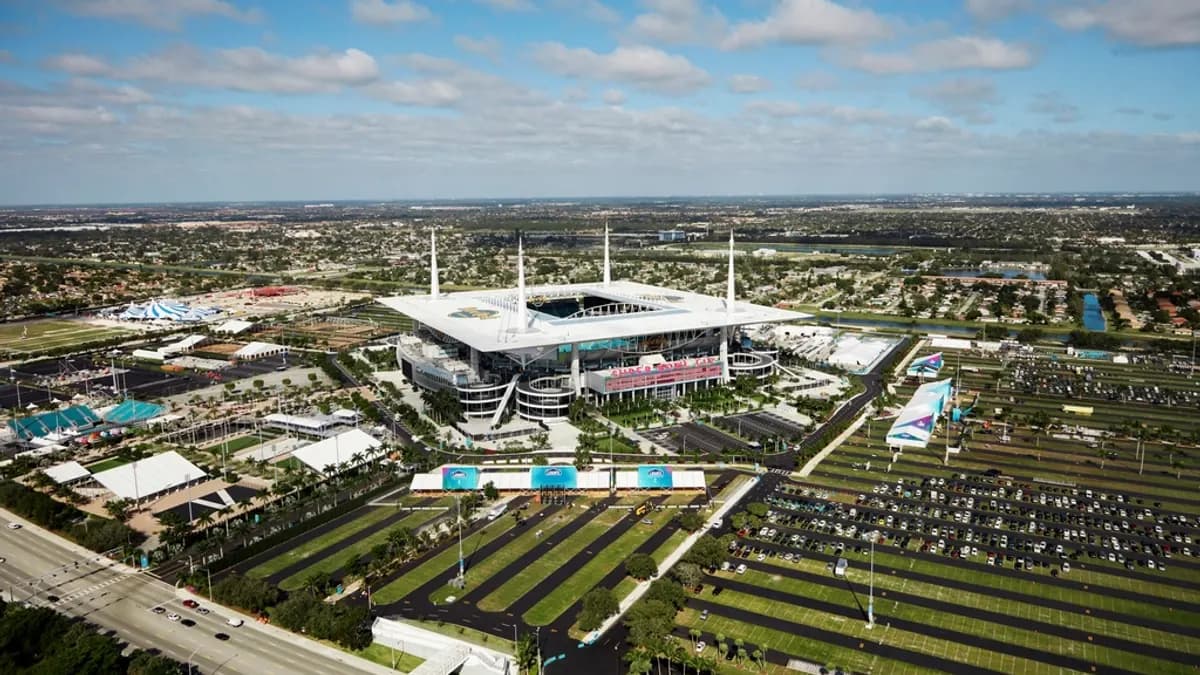
Flying private to a major event means planning around the airports as much as the aircraft. For events such as the Super Bowl, the Masters, the Kentucky Derby and Formula 1 races, the FAA often publishes special traffic procedures, airports may require reservations even for drop-offs, ramps fill up and prices peak. Book as soon as your dates are firm.
Key takeaways
- Reservations are often mandatory. The FAA ran airport reservation programs for Super Bowl LX, the 2025 Las Vegas Grand Prix and the 2026 US Grand Prix in Austin.
- Parking is the scarce resource, not aircraft. Without a slot, expect long delays or denial of service.
- Departure day is the bottleneck. Everyone wants to leave right after the final whistle or checkered flag.
- Prices rise because demand concentrates on a few days and aircraft fly in empty from elsewhere.
- Book early and stay flexible on airport and departure time; that is where the savings and the reliability are.
Why is flying private to major events so hard?
Because thousands of aircraft want the same few airports on the same few days. Airports with room for a few dozen visiting jets suddenly need space for hundreds, and the busiest hour of the event is predictable to the minute.
The FAA manages this with temporary procedures. Its own description of Super Bowl LX week is typical: general aviation pilots flying in the San Francisco Bay Area from February 4 to 10, 2026, had to comply with temporary flight restrictions, special air traffic procedures and additional operational requirements, with special procedures in effect at 17 airports. On game day, a temporary flight restriction centered on Levi's Stadium had a 30-nautical-mile outer ring and a 10-nautical-mile inner core.
Three things change for the passenger:
- Your arrival and departure times may need a reservation, and the reservation may not be at the exact time you want.
- Your aircraft may not be allowed to park at the airport closest to the venue.
- Delays are more likely, because the FAA meters arrivals when demand exceeds capacity.
What are FAA special traffic management programs and slot reservations?
A special traffic management program (STMP) is a temporary set of procedures the FAA uses when an event creates "above normal traffic demand" at a location. The Aeronautical Information Manual explains that each program is announced in a notice giving the dates and times reservations are required, with bookings made through the FAA's web-based e-STMP reservation system.
In practice, event programs take a few forms. The operator, not the passenger, handles them, but it helps to know which one applies.
| Program | What it controls | How it is booked | Recent example |
|---|---|---|---|
| Special event reservation (PPR) | Arrivals, departures and drop-and-go flights at listed airports | Through the FBO or airport authority, as the NOTAM directs | Super Bowl LX, 17 Bay Area airports, Feb. 4–9, 2026 |
| Ramp reservation | Parking and access at one busy airport | Through one of the listed FBOs; the PPR number goes in the flight plan | 2026 US Grand Prix, Austin-Bergstrom (AUS) |
| STMP departure slots | Non-scheduled departures in a peak window | FAA e-STMP system | AUS on race Sunday, Oct. 25, 2026, 4 p.m. to midnight local |
| Traffic management initiatives | Arrival flow, routes and delays | No booking; expect reroutes, holding or ground delays | Masters (Augusta), Kentucky Derby (Louisville) |
The examples come straight from FAA notices:
- Super Bowl LX (Santa Clara, February 2026). The FAA's Super Bowl LX notice ran a Special Event Reservation (PPR) program for arrivals and departures, "including drop-and-go operations," at 17 airports from SFO and San Jose to Monterey and Napa. Operators without reservations were told to expect "significant delays in and out of the area with the possibility of denial of service," and parking at other airports within 60 nm of San Jose was expected to be scarce.
- US Grand Prix (Austin, October 2026). The 2026 US Grand Prix notice requires a ramp reservation for arrivals and departures, drop-and-goes included, at Austin-Bergstrom from October 22 to 26, booked through one of the airport's FBOs. Flights without an approved confirmation number will not be accepted, and parking within 50 nm may be unavailable. A separate STMP for race Sunday requires e-STMP departure reservations for all non-scheduled flights leaving AUS between 4 p.m. and midnight, with roughly 28 to 40 departure slots per hour.
- Las Vegas Grand Prix (November 2025). The FAA notice put a parking reservation system in place at Harry Reid, Henderson Executive, North Las Vegas and Boulder City from November 18 to 25, plus a departure slot program after the race, and asked pilots for identification, aircraft ownership details and a contact number as part of the security provisions.
Scheduled airline flights are exempt from these programs. Private and charter flights should plan on needing a reservation.
What happens at the Masters, the Derby and other events?
Not every event uses reservations, but most big ones bring special procedures, and the details change every year.
- The Masters (Augusta, Georgia). For the April 2026 tournament, the FAA's notice listed possible reroutes, ground stops and delay programs at Augusta Regional (AGS), Daniel Field (DNL), Aiken Regional (AIK) and Thomson-McDuffie (HQU), with temporary control towers at Daniel Field and Aiken and preferred arrival routes for jets.
- The Kentucky Derby (Louisville). The 2026 Derby notice covered Louisville International (SDF), Bowman Field (LOU) and Clark Regional (JVY), which had a temporary tower for the week. It warned that air-filed flight plans might not be accepted and steered propeller aircraft to Bowman Field or Clark Regional because of parking congestion at SDF.
- Formula 1 in Miami. The race runs around Hard Rock Stadium in Miami Gardens, and the region's business aviation airports, such as Miami-Opa Locka Executive (OPF) and Fort Lauderdale Executive (FXE), get busy. Check whether a reservation program applies for the year you fly.
- Art Basel Miami Beach. Early December brings heavy private traffic into South Florida. There is usually no published FAA event program, but popular FBOs fill up, so book parking with the flight.
- Coachella (Indio, California). Palm Springs International (PSP) and Jacqueline Cochran Regional (TRM) in Thermal are the usual airports. Two consecutive festival weekends mean two peaks of arrivals and departures.
Notices for each event usually appear a few weeks before it, and NOTAMs with the final details often only days before. A good operator watches for them on your behalf; ask yours to confirm in writing which programs apply to your trip.
How far in advance should you book?
As soon as your dates are firm. For the biggest events, think weeks or months, not days.
The order in which things sell out is roughly:
- Parking at the closest airport. Reservation programs and FBO ramp space are finite, and well-placed slots go early.
- Aircraft based nearby. Jets based close to your departure point have the lowest repositioning cost; once they are booked, the next aircraft has to fly in from farther away, and you pay for that.
- Departure times right after the event. On Super Bowl Sunday or race day, slots in the first hours after the finish are the most contested.
If you are booking late, be flexible about the airport and willing to leave the morning after rather than the night of. That flexibility often decides whether a trip is possible at all. Our guide to how to charter a private jet covers the booking steps; for events, start them earlier.
Drop-and-go or park? Which is better?
Drop-and-go is often easier to arrange when parking is scarce; parking is more convenient if you need to leave on your own timetable. The right answer depends on how long you are staying.
Drop-and-go: the jet lands, you get off, and it leaves. Useful when the closest airport has no parking or when you are staying several days. Note that event programs such as the Super Bowl and Austin reservations explicitly cover drop-and-go flights, so you still need a slot. You also pay for the aircraft to fly away empty and back again to collect you, unless the operator can sell those legs as empty legs.
Park nearby, reposition for departure: the aircraft drops you at the event airport, flies to a less crowded airport 30 to 100 miles away to park, then returns for your departure. You pay for the extra flight time, but the jet is close if plans change.
Park at the event airport: the simplest option for the passenger, and the hardest to secure. Expect to book far ahead and to pay higher parking fees during the event.
Add a helicopter: for venues with event helipads, landing at a larger airport and finishing by helicopter can beat the traffic on event day. See when a helicopter beats a jet and our helicopter charter page.
How much more does it cost to fly private to big events?
Expect prices at the top of the usual range or above it, and quote early to see real numbers. We do not publish event surcharges because they vary by operator, aircraft and year.
Normal US retail rates for light jets run about $4,000 to $5,900 per flight hour and super midsize jets about $6,500 to $9,800 (typical ranges, before taxes and fees). Event trips cost more for structural reasons:
- Demand concentrates on a few days, so operators price to the market.
- Repositioning. When local aircraft are booked, the jet flies in empty from elsewhere, and that time is billed.
- One-way pricing. Everyone flies in on Friday and out on Sunday, so aircraft often fly the opposite way empty.
- Crew and waiting costs. Multi-day trips add crew hotels, per diems and, in some cases, daily minimums.
- Parking and handling fees at FBOs apply and can be higher during events; ask for them to be itemized in the quote.
Ways to soften the cost: share the aircraft with a group, fly in a day early or leave a day late, consider a slightly farther airport, and watch for empty legs heading away from the event once it is over. More ideas are in our guide to saving money on charter, and you can rough out a budget with the private jet charter cost calculator.
Event planning checklist
When you first book
- Fix dates and passenger count, and share them with your broker as early as possible.
- Ask which airports are closest to the venue, and which have FAA or FBO reservation programs this year.
- Decide between parking at the event airport, parking elsewhere and drop-and-go.
- Confirm the quote includes repositioning, crew overnights, parking and event fees.
- Ask what happens if your reservation time is not available: a nearby time, or a different airport?
In the weeks before
- Confirm the reservation or PPR number is in place for both arrival and departure.
- Check ground transport times from the FBO to the venue on event day, not on a normal day.
- Book any helicopter or car connection to match the reserved arrival time.
- Send passenger names and ID details if the event's security provisions require them.
On the day
- Leave margin. Airborne holding, reroutes and ground delays are common during events.
- Be at the FBO early for departure; reserved slots do not wait.
- Keep your broker's number handy for last-minute changes.
Common mistakes to avoid
- Booking the flight but not the parking. A confirmed aircraft without an airport reservation may not be allowed to land.
- Assuming you can leave the moment it ends. Post-event departure slots are rationed; build in time or plan to leave the next morning.
- Fixating on one airport. A field 40 minutes farther away can mean easy parking and a cheaper trip.
- Leaving it late. At the biggest events, the best-placed aircraft and slots go first. More pitfalls are in our list of easily avoidable booking mistakes.
Planning a trip to a big event? Tell us the dates and passenger numbers through our quote request, and we will check which programs apply and which airports still have room.