

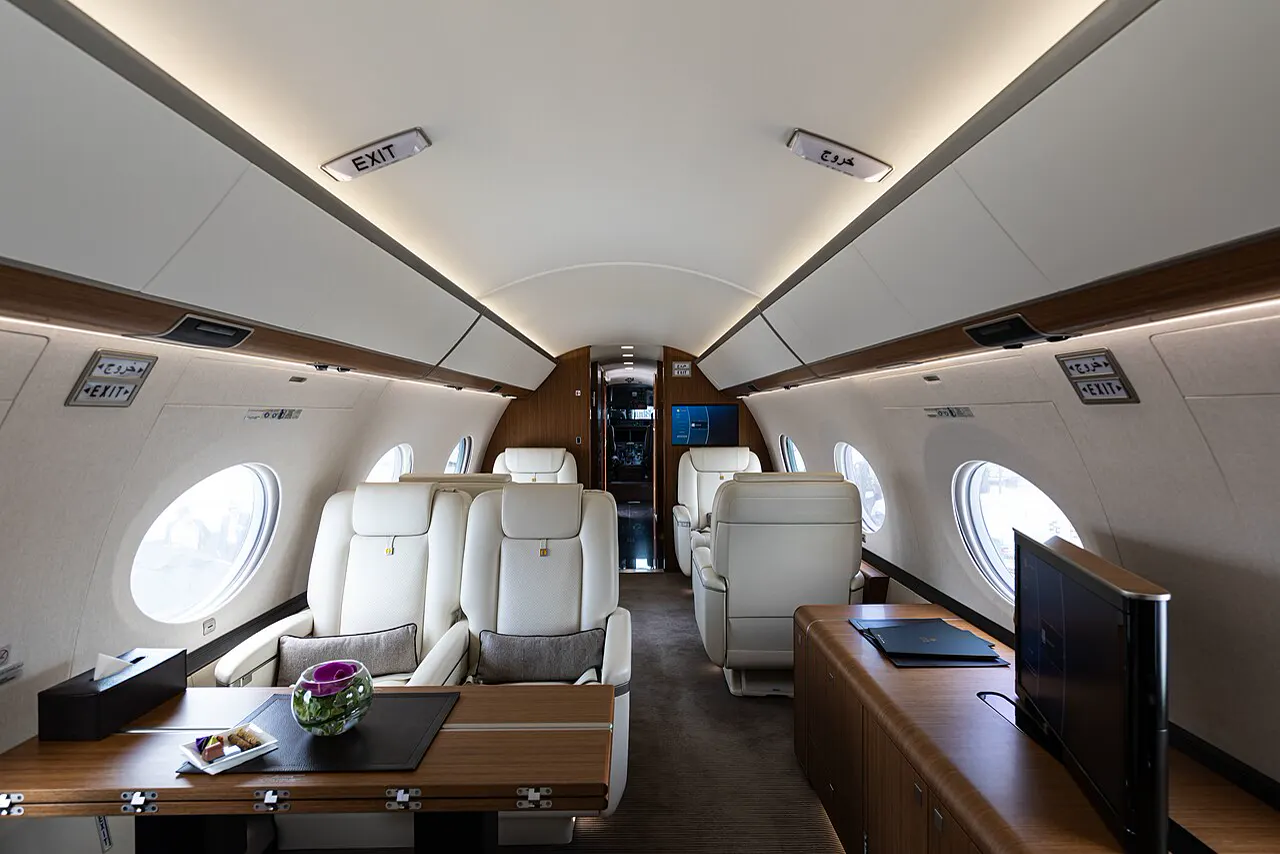
To charter a private jet, decide your route, dates and passenger count, choose a provider, request quotes, compare the aircraft and total price, check that a certificated FAA Part 135 operator will fly the trip, sign the charter agreement and pay. On the day, you arrive at a private terminal 15 to 30 minutes before departure. There is no membership needed, and trips can often be arranged within days.
Key takeaways
- Start with the trip, not the aircraft. Passengers, baggage and distance decide the right jet class, and the class drives most of the price.
- Compare total quotes, not hourly rates. Repositioning, fees and taxes can change the final number significantly.
- Always know the operator. The company flying you must hold an FAA Part 135 certificate, and you can verify it on a public FAA list.
- Read the cancellation terms before you pay. They vary by operator and by how close to departure you cancel.
Step 1: How do you work out what you need?
Write down five facts before you ask for a quote. They determine which aircraft can do the trip and what it will cost.
- Route and dates. Departure and destination cities, preferred airports, dates and times, and how flexible you are. Flexibility of even a few hours can open up cheaper options.
- Passengers. The exact number, including children and pets.
- Baggage. Number and size of bags, and anything bulky such as golf clubs, skis or strollers.
- One way or round trip. If you return within a few days, the aircraft may wait for you; if not, it may fly home empty and come back, which you usually pay for.
- Priorities. Stand-up cabin, enclosed lavatory, Wi-Fi, sleeping room, catering, a two-pilot crew.
Step 2: Which size of jet do you need?
Choose the smallest class that carries your group and bags comfortably and flies the route nonstop or with an acceptable fuel stop. Here are typical figures for each class.
| Class | Typical seats | Typical range | Typical hourly rate (US) | Good for |
|---|---|---|---|---|
| Turboprops | 6–9 | 1,100–1,800 nm | $2,000–3,400 | Short trips, short runways |
| Very light jets | 4–6 | 1,100–1,550 nm | $3,000–4,300 | 1–4 people, 1–2 hour flights |
| Light jets | 6–8 | 1,500–2,200 nm | $4,000–5,900 | The most popular US charter class |
| Midsize jets | 7–9 | 1,800–2,900 nm | $5,000–7,200 | Stand-up cabin, 2–4 hour flights |
| Super midsize jets | 8–10 | 3,100–4,000 nm | $6,500–9,800 | Coast to coast nonstop |
| Heavy jets | 10–16 | 3,400–6,000 nm | $8,500–13,000 | Larger groups, transatlantic |
| Ultra long range | 12–17 | 6,000–7,700 nm | $11,000–17,500 | Intercontinental nonstop |
Rates are typical US retail on-demand ranges per flight hour before taxes and fees; quotes vary with availability and season. Real-world range falls with full passenger loads, headwinds and winter weather, so allow a margin. Check a specific route on the range explorer and estimate flight time with the flight time calculator. For a deeper comparison, read light vs midsize vs heavy jets.
Step 3: Should you book through a broker, an operator or a jet card?
For most first-time and occasional flyers, on-demand charter through a broker or directly with an operator is the simplest option. The main routes are:
- Charter broker. Compares aircraft from many operators and manages the trip. Ambition Jets works this way.
- Operator direct. Sells only its own certificated aircraft. Useful when its fleet and base suit your route.
- Jet card. Prepaid or committed hours at fixed rates, usually with guaranteed availability. Best for people flying roughly 25 hours a year or more.
- Membership. An annual fee for access or pricing benefits. Terms vary widely.
- Empty legs. Discounted one-way repositioning flights on fixed routes and times. See empty legs.
Whichever you choose, the flight itself must be operated by a Part 135 certificate holder. Our guide to charter brokers vs operators explains who does what, and how to find the best charter provider compares cards, memberships and fractional ownership.
Step 4: Request quotes
Send your provider the facts from Step 1 in one message. The more precise you are, the more accurate the quote. A useful request reads like this: "Four passengers, Van Nuys to Aspen, Friday 9 a.m., returning Monday afternoon, six bags plus two sets of skis, light or midsize jet, two pilots, Wi-Fi preferred."
Before you have a quote, you can estimate the budget with the private jet charter cost estimator. For what drives the number up or down, see private jet charter cost in 2026.
Step 5: How do you compare private jet quotes?
Compare the total price for the same aircraft class on the same itinerary, and check what each quote includes. A complete quote shows:
- The aircraft: model, year of manufacture or last refurbishment, seat count, and recent photos.
- The operator: the legal name of the Part 135 operator in operational control, and its safety audit ratings.
- The itinerary: each leg, including any repositioning legs you are paying for.
- Every cost: flight time, repositioning, taxi time, crew overnight costs, landing and handling fees, any international fees, and taxes.
US charter is subject to the 7.5% federal excise tax plus per-passenger segment fees, and international trips have their own per-passenger taxes; our federal excise tax guide has the current figures and a tax calculator.
If you book through a broker, US rules give you specific rights. Under 14 CFR Part 295, the broker must tell you the operator's name before you sign, and on request must give you the total cost including taxes and fees, plus any fees you will pay third parties directly, such as fuel, landing or hangar fees.
Ask what could be added after the flight. De-icing, extra waiting time, catering upgrades and Wi-Fi usage are common extras, and they are easier to agree up front than to dispute later.
Step 6: Check the operator and aircraft
Before you pay, confirm that the operator is certificated and the aircraft is authorized for charter. This takes a few minutes:
- Get the operator's name and the aircraft's registration (its N-number).
- Find both on the FAA's list of Part 135 operators and aircraft, which the FAA updates weekly.
- Ask for the operator's insurance certificate and any ARGUS, Wyvern or IS-BAO audit results.
- Ask whether the trip will have two pilots.
The FAA's guidance for charter passengers is blunt: ask to see the operator's certificate, and "if the deal sounds too good to be true, it probably is." For what the audits mean and the red flags of illegal charter, read is private jet charter safe? and our safety standards.
Step 7: Sign the charter agreement and pay
Once you choose an option, you sign a charter agreement and pay, usually in full before departure by wire transfer or card. Read four parts of the agreement closely:
- Cancellation terms. Many charges rise as departure approaches. Know the deadlines.
- Aircraft substitution. What happens if the aircraft has a mechanical problem: how a replacement is chosen, whether it will be of equal or better class, and whether you can decline it.
- Delays and weather. The operator's captain decides whether it is safe to fly. Know how delays and diversions are handled and charged.
- Final invoice. Which costs are fixed and which are billed after the flight.
US brokers must make prompt refunds when a flight cannot be performed: within 20 days of a complete request for cash and check purchases, and under federal credit card rules for card payments (14 CFR 295.26).
Step 8: How do you prepare for the flight?
Send your advisor the passenger details and requests at least a day ahead, or as soon as you can for short-notice trips:
- Passenger manifest. Full names as on ID, dates of birth, and passport details for international trips.
- Catering and preferences. Meals, drinks, dietary needs, and any special occasion.
- Ground transport. Cars at both ends, with the driver brought to the aircraft where the FBO allows it.
- Pets. Size, breed and documents. Many operators accept pets in the cabin, but policies vary.
- Baggage. Any late changes to the number or size of bags, so the crew can plan weight and balance.
- International trips. Check passports, visas and entry rules for every passenger. The operator files the customs and immigration paperwork, but each traveller is responsible for valid documents.
Step 9: What happens on the day?
You drive to the FBO, the private terminal on the general aviation side of the airport, rather than the airline terminal. Arrive 15 to 30 minutes before departure with government-issued photo ID, or passports for international flights.
- The FBO staff or crew usually check your ID against the manifest, then load your bags.
- The captain or a crew member gives a safety briefing. Listen to it, and wear your seat belt whenever you are seated.
- If weather or a technical issue causes a delay, the crew will explain. Leave buffer time in your plans for important meetings.
- On arrival, your car can often meet you near the aircraft, and bags are unloaded for you.
Any extras incurred on the trip, such as de-icing or added waiting time, appear on a final invoice. Check it against your agreement.
Mistakes to avoid when chartering
- Choosing on the hourly rate alone. The total price is what you pay.
- Underestimating baggage. Light jets have limited hold space for skis and golf bags.
- Booking too late for peak dates. Holidays and big events sell out early.
- Not knowing who operates the flight. Always get the operator's name.
- Ignoring the cancellation terms. Read them before you pay.
There are more in easily avoidable booking mistakes.
Ready to charter?
Gather your route, dates, passengers and baggage, then request a quote or call 1-800-647-0677. An Ambition Jets advisor will send options that name the aircraft and operator, list every cost, and guide you through each step to landing.