

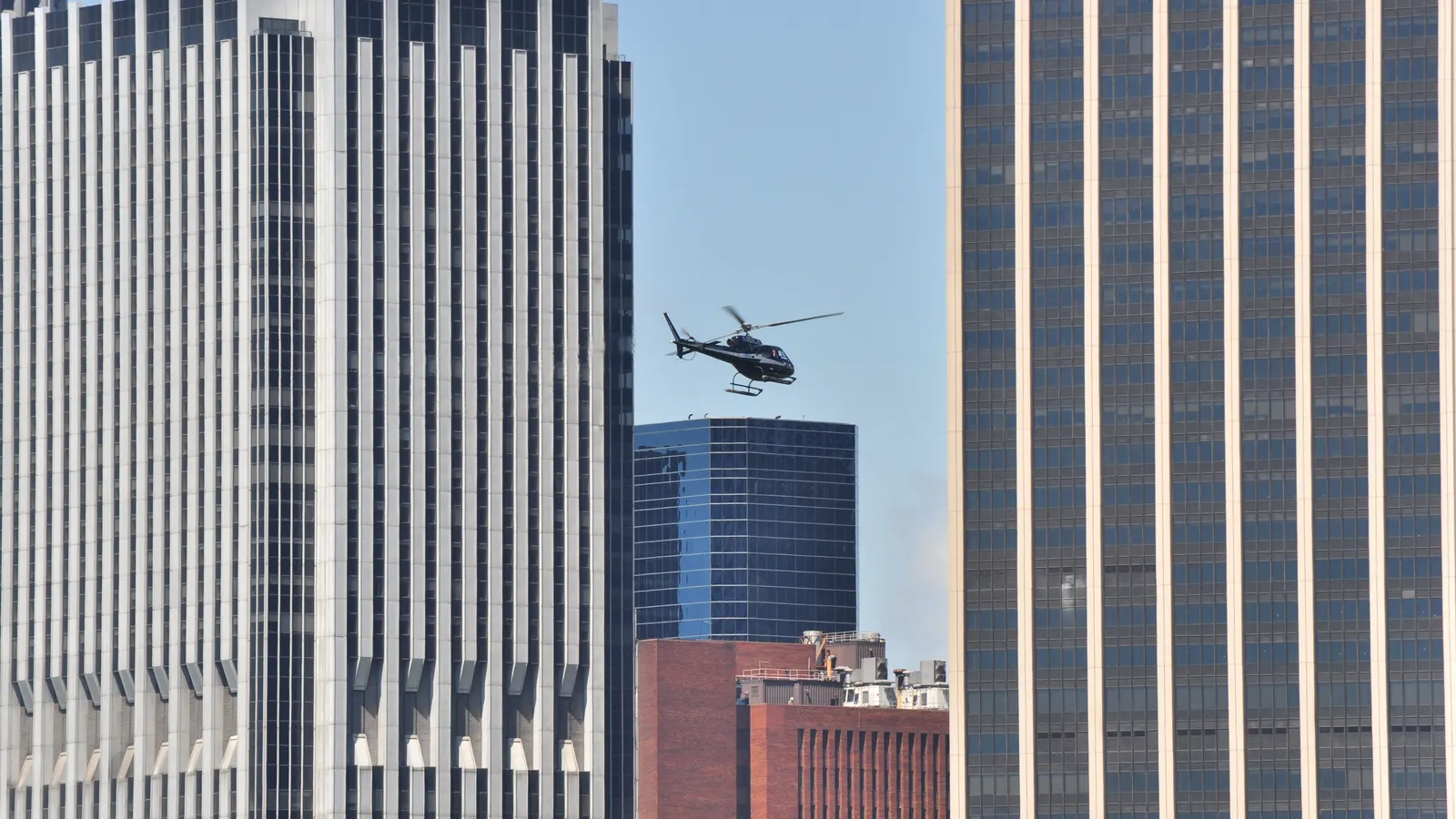
A helicopter beats a private jet on short trips, roughly under 150 miles, where it can land at a heliport or private pad close to where you are going and skip the drive to and from an airport. Charter helicopters typically cost $3,500 to $7,000 per flight hour, cruise at about 130 to 165 knots and carry four to eight passengers with light luggage.
Key takeaways
- Under about 150 miles, think helicopter. Over 200 to 250 miles, a jet is almost always faster door to door.
- The helicopter's advantage is access, not speed. It lands at city heliports, resort pads and event helipads that no jet can use.
- Weather and baggage are the real limits. Low cloud grounds more helicopter flights than jet flights, and cabins hold soft bags, not trunks.
- Twin-engine models such as the Bell 429, Sikorsky S-76, AW109 and AW139 are common choices for executive charter.
- The best trips often use both: a jet for the long leg, a helicopter for the last 20 to 80 miles.
When is a helicopter faster than a private jet?
A helicopter is faster when the ground transfer to and from the airport takes longer than the flight itself. That usually means trips of roughly 20 to 150 miles, especially from dense cities.
The arithmetic is simple. A light jet cruises at around 440 knots; a charter helicopter at about 145. But the jet has to start and finish at an airport with a runway, while the helicopter can often start a few blocks from your office and finish at the edge of your destination.
Take Manhattan to East Hampton. The great-circle distance from the West 30th Street Heliport to East Hampton Town Airport (HTO) is about 80 nautical miles, a little over half an hour of cruise at 150 knots before routing and approach. To do the same trip by jet, you first drive to Teterboro or Westchester, fly a short leg, then drive from the airport at the other end. On a summer Friday, the drive to the jet can take longer than the whole helicopter flight.
Now stretch the distance. On a 300 nm trip, the helicopter needs about two hours in the air; a light jet needs well under one. Even with drives at both ends, the jet pulls ahead somewhere around 200 to 250 miles, and its pressurized cabin, lavatory and baggage hold make it the more comfortable choice too. You can check jet times on any route with our flight time calculator and compare the price with the private jet charter cost estimator.
| Trip length | Usually best | Why |
|---|---|---|
| Under 20 miles | Car | Boarding and briefing time cancel out the flight savings |
| 20–150 miles | Helicopter | Lands close to the door; avoids traffic at both ends |
| 150–250 miles | Depends | Helicopter if both ends are far from airports; otherwise a jet or turboprop |
| Over 250 miles | Jet or turboprop | Three times the cruise speed, more comfort and baggage space |
Where can a helicopter land that a jet cannot?
Helicopters can use heliports, rooftop pads (where the building permits it), private estates, resort helipads and temporary event pads, as well as every airport a jet uses. That access is the whole point.
New York is the clearest example. Manhattan has three public-use heliports: the Downtown Manhattan Heliport at Pier 6 and the East 34th Street Heliport, both city-owned, and the state-owned West 30th Street Heliport. According to the New York City Council's summary of heliport rules, East 34th Street has been closed to sightseeing since 1997 and serves air taxi, commuter and general aviation flights, while only the Downtown heliport may run sightseeing tours. Opening hours and access rules differ by heliport and change from time to time, so the operator confirms them when it quotes.
The Hamptons are the other classic run. Helicopter flights from Manhattan commonly land at East Hampton Town Airport, whose operating rules have been the subject of years of litigation and local regulation. Ask for the current curfew and any noise-abatement procedures before you set a departure time.
Elsewhere, the pattern repeats: Los Angeles to a hotel pad in Santa Barbara or a ranch in Ojai, Miami to a waterfront estate, or Austin-Bergstrom to the helipads at Circuit of the Americas during the Grand Prix, where the FAA's 2026 US Grand Prix notice provides for helicopter operations to and from the track's helipads. Landing on private property needs the owner's permission and must meet FAA and local rules; the operator's chief pilot decides whether a site is suitable.
Which helicopters are used for private charter?
Executive charter in the US centers on a handful of light and medium helicopters. The table uses manufacturer figures where noted and the rounded figures in our helicopter guide for the models we list.
| Helicopter | Engines | Passengers (typical) | Cruise | Notes |
|---|---|---|---|---|
| Bell 407GXi | Single | Up to 5 | ~133 kt | Light single; lower cost on short hops |
| Bell 429 | Twin | 6 (up to 7) | ~155 kt | Modern light twin; single-pilot IFR capable |
| AW109 Trekker | Twin | Up to 6 | ~148 kt | Light twin |
| Sikorsky S-76 | Twin | 6 | ~150 kt | Medium twin long used for executive transport |
| AW139 | Twin | Up to 15 (VIP cabins fewer) | ~165 kt | Large medium twin; roomy, at the top of the price range |
A few details behind those numbers:
- Bell 407GXi. Business Jet Traveler's pilot report describes a light single with an 862 shp Rolls-Royce turboshaft, seating for up to five passengers in corporate layout and a maximum cruise of 133 knots at gross weight.
- Bell 429. Bell's specifications list two Pratt & Whitney Canada PW207D1/D2 engines, seating for up to seven passengers and single-pilot IFR capability. Executive cabins are usually set up for six.
- AW109 Trekker and AW139. Leonardo lists the AW109 Trekker with two PW207C engines, up to six passengers and a 148-knot maximum cruise, and the AW139 with two PT6C-67C engines, up to 15 passengers and a 165-knot cruise. Charter AW139s are normally configured with far fewer, larger seats.
- Sikorsky S-76. A twin-engine medium helicopter with a long record in corporate and offshore work. Later S-76D models use twin Pratt & Whitney Canada PW210S engines.
Availability varies a lot by city. New York and South Florida have deep helicopter markets; in other regions the choice may be one or two types.
Single engine or twin engine?
For executive charter, most clients choose a twin, and for anything over water, at night or in marginal weather, it is the sensible default. A single is a reasonable, cheaper choice for short daytime hops in good weather.
Why twins: if one engine fails, a twin can keep flying on the other. A single-engine helicopter that loses its engine makes a controlled descent called an autorotation, which needs a suitable place to land below it. Twins also tend to be the IFR-equipped aircraft in a charter fleet, and FAA charter rules restrict single-engine aircraft more: under 14 CFR 135.181, no one may carry passengers over the top of clouds in a single-engine aircraft unless it could descend under visual rules if the engine failed.
Why singles: lower hourly cost, and on a 25-minute daytime hop over land in clear weather, the practical difference for most passengers is small.
Whatever the engine count, the operator matters more than the model. Ask who holds the Part 135 certificate, how experienced the pilots are on type and whether the operator has third-party audits. Our safety and certifications page explains what to look for.
How does weather affect a helicopter charter?
Weather cancels or delays more helicopter flights than jet flights. Plan any helicopter trip with a ground or jet backup if the timing matters.
Three reasons:
- Visual flying. Many helicopter charters fly under visual flight rules (VFR). For charter helicopters flying low in uncontrolled airspace, 14 CFR 135.205 sets a minimum flight visibility of half a mile by day and one mile at night, and operators often set stricter limits of their own. Low cloud, fog and heavy rain can stop a VFR flight at either end.
- Heliports without instrument approaches. Even an IFR-capable helicopter needs a published instrument procedure to land in cloud. Many heliports and private pads have none.
- Wind and icing. Strong gusts at a rooftop or waterfront pad, and icing conditions in cold weather, are limits for many helicopter types.
A good operator will make a weather call a few hours before departure and tell you whether the plan holds. If the flight cancels, a car or a jet from a nearby airport is the usual fallback; ask how the operator handles payment when weather cancels a flight.
How much luggage can you take on a helicopter?
Expect room for a few soft weekend bags, not a stack of hard suitcases. Space and weight both limit what you can carry.
A Phenom 300 light jet has about 84 cubic feet of baggage space. A Sikorsky S-76 has about 38. Bell lists 74 cubic feet for the Bell 429's aft compartment, but in a helicopter, weight runs out before space does: on a hot day with a full cabin and full fuel, the pilot may have to limit bags or passengers.
Practical rules:
- Send the operator each passenger's approximate weight and the number, size and weight of bags when you book.
- Pack soft-sided bags. Hard shells may not fit the baggage door.
- Golf bags, skis and surfboards need confirming in advance; some types can take them, some cannot.
- Ship heavy luggage separately, or send it ahead by car, on a Hamptons weekend.
How much does a helicopter charter cost?
Typical US retail rates for charter helicopters run $3,500 to $7,000 per flight hour as of October 2026, before taxes and fees. These are typical ranges; real quotes vary by operator, aircraft, date and demand.
What moves the price:
- Size and engines. A light single sits toward the lower end; medium twins such as the S-76 and AW139 sit at the top.
- Repositioning. As with jets, you usually pay for the helicopter to fly from its base to your pickup and back.
- Wait time and minimums. Ask how waiting time, overnight stays and any minimum billing are charged.
- Peak days. Summer Fridays to the Hamptons and big event weekends fill up early and price at the top of the range.
- Taxes and landing fees. Charter helicopter flights are commercial air transportation, so the federal excise taxes that apply to jet charter generally apply too. Heliports charge their own landing fees.
For a short city-to-resort hop, a helicopter can cost less than positioning a jet, because the jet has to fly empty to your airport, land, wait and fly home. For a 250-mile trip, the jet will usually be cheaper per mile and far faster.
How do you combine a private jet and a helicopter?
Fly the long leg by jet and the last stretch by helicopter. This is how many travelers reach Manhattan, the Hamptons, ski resorts, racing circuits and stadiums.
The usual pattern:
- Jet into a large business aviation airport close to your destination: Teterboro or Westchester for New York, Van Nuys for Los Angeles, Austin-Bergstrom for the US Grand Prix. Our guide to the top private jet airports in the US covers the main options.
- Helicopter waits at the same FBO. You walk from one aircraft to the other, with bags transferred by the ground crew.
- Land at the heliport, hotel pad or event helipad closest to where you need to be.
Timing is the hard part. If your jet is delayed, the helicopter crew's duty day and the heliport's opening hours still apply. Book both through one broker so a single person is tracking the jet's arrival and adjusting the helicopter. For major events, the FAA often runs special reservation programs that apply to helicopters as well as jets; see our guide to flying private to major events.
Checklist: is a helicopter right for this trip?
- Is the trip under about 150 miles, with heavy traffic or a long drive at either end?
- Is there a heliport or approved landing site close to where you are going?
- Can everyone travel with soft bags under the weight limit the operator gives you?
- Is there a backup if weather cancels the flight?
- Do you want a twin engine? (Ask for it by name.)
- Is the landing site open at your arrival time, and is there a curfew?
If most answers are yes, a helicopter will likely save you real time. Tell us the route, passengers and bags on our helicopter charter page, or request a quote for a combined jet and helicopter trip, and we will compare both options for you.