

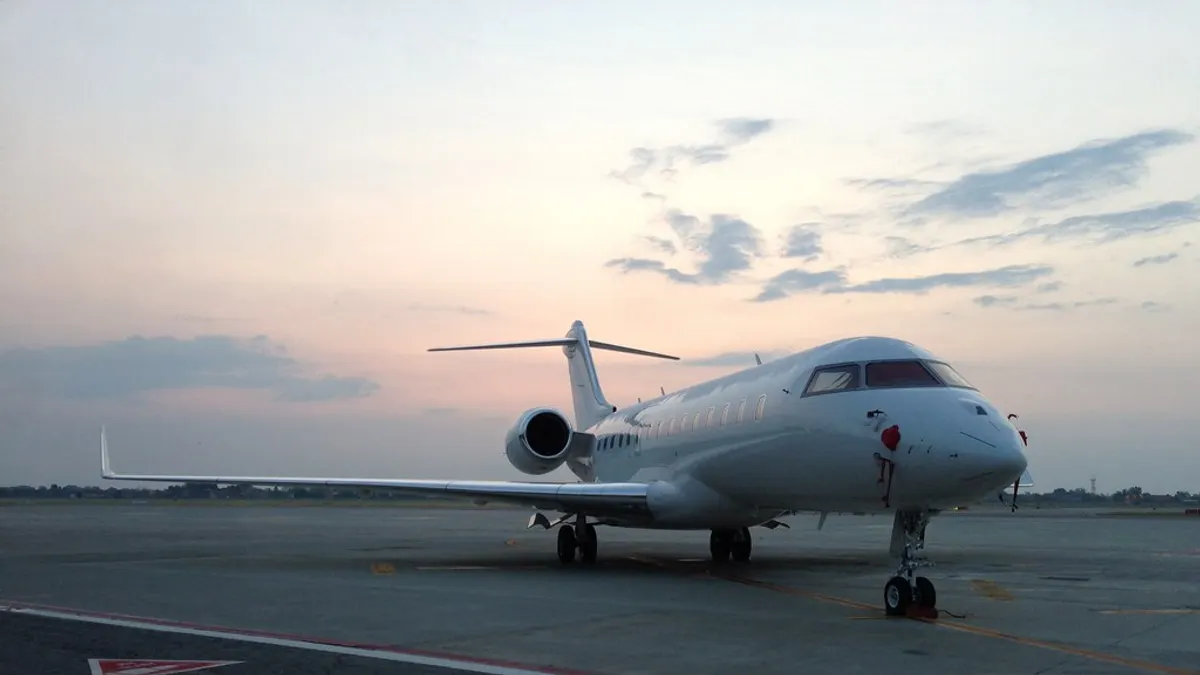
Most private jets cruise at about 390 to 490 knots, or roughly 450 to 565 mph. Light jets cruise near 440 knots and ultra long range jets near 490 knots in the aircraft data behind our tools, while turboprops fly at about 290 knots. The fastest business jets in production, such as the Gulfstream G700 and G800, have a maximum operating speed of Mach 0.935.
Key takeaways
- Speed barely changes with size. From light jets to ultra long range jets, typical cruise rises by only about 50 knots.
- Turboprops are the slow exception, about a third slower than light jets, which matters on trips over an hour or two.
- Real flight time depends on climb, descent, routing and wind as much as top speed.
- Private jets save most time on the ground, not in the air.
- Choose a jet for range and cabin first, and treat speed as a small bonus.
How fast do private jets fly by class?
Typical cruise speeds by class, from the aircraft data behind our tools, are shown below. Knots are nautical miles per hour; one knot is about 1.15 mph.
| Class | Typical cruise | In mph | Example aircraft |
|---|---|---|---|
| Turboprops | ~290 kts | ~335 mph | Pilatus PC-12 |
| Very light jets | ~390 kts | ~450 mph | Phenom 100, HondaJet |
| Light jets | ~440 kts | ~505 mph | Phenom 300E, Citation CJ4 |
| Midsize jets | ~445 kts | ~510 mph | Citation Latitude |
| Super midsize jets | ~465 kts | ~535 mph | Challenger 350, Citation Longitude |
| Heavy jets | ~470 kts | ~540 mph | Falcon 7X, Gulfstream G450 |
| Ultra long range jets | ~490 kts | ~565 mph | Gulfstream G650ER, Global 7500 |
Manufacturers publish the figures behind these averages. Cessna lists the Citation CJ4 at a maximum cruise speed of 451 knots and the Citation Longitude at 483 knots, and Pilatus lists the PC-12 at 290 knots. Speed affects cost through flight time, so our private jet charter cost estimator uses these class speeds to estimate how many hours you are billed.
What is the fastest private jet?
The fastest business jets in production fly at up to Mach 0.935, about 93.5% of the speed of sound. Gulfstream lists a maximum operating Mach number of 0.935 for both the G700 and the G800. At typical cruising altitudes above 36,000 feet, where the speed of sound is about 573 knots in standard conditions, that is roughly 535 knots.
Two caveats:
- Maximum speed is not normal cruise. Jets usually fly a little slower to save fuel and extend range. Gulfstream, for example, quotes the G800's range at Mach 0.85, not at its maximum speed.
- Smaller jets have lower limits. Cessna lists the Citation CJ4's maximum limit speed at Mach 0.77 and the Longitude's at Mach 0.84.
No business jet in service today is supersonic. Under 14 CFR 91.817, civil aircraft may not fly faster than Mach 1 over the United States without special authorization.
Why is a bigger jet barely faster?
Because speed is limited by aerodynamics, not size. All jets in this market fly in the same band below the speed of sound, where drag rises sharply. Bigger jets carry more fuel and passengers farther, but they do not go much faster.
On real trips, the difference is small. Estimated still-air flight times at typical class speeds, including about 18 minutes for taxi, climb and descent:
| Distance | Turboprop | Light jet | Super midsize | Ultra long range |
|---|---|---|---|---|
| 200 nm | 1 h 02 min | 47 min | 45 min | 44 min |
| 500 nm | 2 h 07 min | 1 h 30 min | 1 h 26 min | 1 h 22 min |
| 1,000 nm | 3 h 56 min | 2 h 42 min | 2 h 34 min | 2 h 27 min |
| 2,000 nm | 7 h 34 min | 5 h 05 min | 4 h 50 min | 4 h 36 min |
A light jet and an ultra long range jet are about 15 minutes apart on a 1,000 nm trip, while the hourly rate roughly triples. The turboprop gap is real, though: over an hour slower at 1,000 nm. For short hops of under an hour, a turboprop's lower hourly rate often outweighs the few extra minutes.
What affects how long a private jet flight takes?
Five factors matter more than top speed.
- Climb and descent. Jets fly slower while climbing and descending, so short flights average well below cruise speed.
- Speed limits near the ground. Under 14 CFR 91.117, aircraft may not exceed 250 knots indicated airspeed below 10,000 feet unless the FAA approves otherwise, and 200 knots close to airports in Class C or D airspace.
- Wind. Prevailing westerly winds at cruising altitude usually make eastbound flights faster and westbound flights slower, sometimes by an hour or more on long routes.
- Routing. Air traffic control routes and airways are rarely a straight line, and busy airports add holding or vectoring.
- Fuel stops. A stop adds landing, refueling and another climb; see how far a private jet can fly.
How high do private jets fly?
Most business jets are certified to fly as high as about 41,000 to 51,000 feet, the upper end above typical airline cruising levels. Certified ceilings in our tools' data range from 41,000 feet for many light and midsize jets to 51,000 feet for several heavy and long-range models; Cessna, for example, lists the Citation Longitude's maximum operating altitude at 45,000 feet. Turboprops fly lower, typically up to about 30,000 to 35,000 feet.
Flying high helps in three ways:
- Efficiency. Thinner air means less drag, so jets burn less fuel at altitude, which is part of what makes long nonstop flights possible.
- Smoother rides. Cruising above much of the weather and airline traffic can mean fewer bumps and more direct routings.
- Wind choices. Crews can pick altitudes with lighter headwinds or stronger tailwinds, which can shorten a long flight more than a few knots of extra speed.
On short trips, a jet may never reach its ceiling: it climbs, cruises briefly and descends. That is another reason flight times on short hops differ little between classes.
Real private jet flight times
Typical still-air flight times on popular routes, using straight-line distances and typical class speeds:
| Route | Distance | Class | Est. time |
|---|---|---|---|
| Los Angeles (Van Nuys) to Las Vegas | 200 nm | Light jet | 47 min |
| New York (Teterboro) to Palm Beach | 900 nm | Light jet | 2 h 27 min |
| Chicago to New York | 630 nm | Light jet | 1 h 48 min |
| New York to Aspen | 1,500 nm | Midsize jet | 3 h 51 min |
| New York to Los Angeles | 2,130 nm | Super midsize jet | 5 h 07 min |
| New York to London | 2,990 nm | Heavy jet | 6 h 59 min |
Eastbound flights often beat these times and westbound flights take longer. For any city pair, the flight time calculator adds wind and fuel stops to the estimate.
Is flying private faster than flying commercial?
Usually yes, but mostly because of time saved on the ground. In the air, a private jet and an airliner fly at similar speeds. The difference is everything around the flight:
- No check-in or security line. Most charter passengers arrive at the private terminal 15 to 30 minutes before departure; see what an FBO is.
- Closer airports. Private jets use smaller airports nearer to where you are going.
- Nonstop routing. You fly direct, without connections.
- Your schedule. The aircraft leaves when you are ready.
On a typical domestic trip, those savings can be measured in hours. Our comparison of private jet vs first class works through door-to-door time on common routes.
Choosing a jet when speed matters
If you are short on time, pick the airport and the schedule first, then the aircraft. A bigger jet rarely saves more than a few minutes, so spend your effort where the hours are:
- Fly nonstop. Avoiding a fuel stop saves far more time than a faster cruise speed. Choose an aircraft whose range covers your trip with margin.
- Use the closest airport. A smaller airport near your destination can cut more from the door-to-door time than any aircraft upgrade.
- Fly east when you can choose. If your schedule is flexible, the eastbound leg of a long trip is usually the quicker one.
- Skip the turboprop on longer legs. Beyond about an hour of flying, a light jet's speed advantage becomes noticeable.
Choose the smallest jet that flies your trip nonstop with a comfortable cabin. Estimate your trip with the charter cost calculator, then request a quote.