

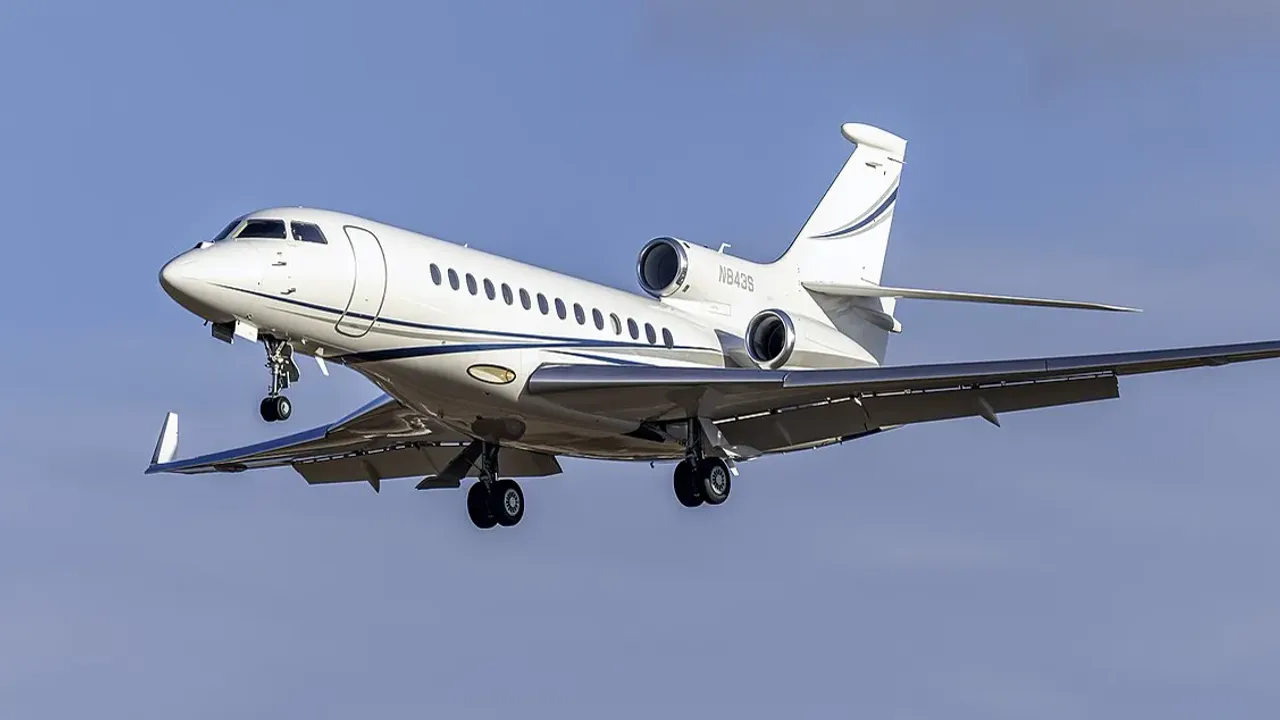
A private jet beats first class on door-to-door time on most US trips, saving roughly two hours of airport time each way, plus any connection. It wins on cost per seat only when you fill several seats on a short or mid-length route. For one or two people flying nonstop between major hubs, or for long international flights, first class is usually the better value.
Key takeaways
- Airlines such as Delta ask passengers to arrive 2 hours before a domestic flight and 3 hours before an international one. Charter passengers typically arrive 15–30 minutes before departure.
- A light jet costs a typical $4,000–$5,900 per flight hour, so the seat cost depends almost entirely on how many people share it.
- Private flights can use far more airports: the FAA counts about 4,900 public-use airports in the US, against 390 primary airports that carry nearly all airline passengers.
- First class remains the smart choice for solo travellers, long international flights and routes with a good nonstop schedule.
Private jet vs first class at a glance
| Factor | First class (US airline) | Private charter |
|---|---|---|
| Arrive before departure | 2 hours domestic, 3 hours international (Delta guidance) | Typically 15–30 minutes |
| Security | TSA checkpoint | Usually no TSA checkpoint; operator checks ID |
| Schedule | Fixed airline timetable | You choose the departure time |
| Airports | About 390 primary airline airports | Any suitable airport with a long enough runway |
| Connections | Common outside major hubs | Usually nonstop, within aircraft range |
| Price basis | Per seat | Per aircraft, by flight hour |
| Who else is on board | Other passengers, shared cabin | Only your group |
| Changes | Airline change rules | Operator terms; aircraft waits for you within reason |
| Best for | 1–2 travellers on hub-to-hub routes | Groups, tight schedules, smaller airports |
Is a private jet really faster door to door?
Yes, on most domestic trips, because most of the time saving happens on the ground rather than in the air. A business jet cruises at about the same speed as an airliner, so the flight itself is similar. What changes is everything before and after it.
The airline side
Delta's published guidance is to arrive at least 2 hours before a domestic departure, check bags at least 45 minutes before and be at the gate 15 minutes before. For international flights it recommends arriving 3 hours before and being at the gate 45 minutes before. First class gets you shorter queues and a lounge, but the clock still starts at the terminal curb. After landing you still taxi to a gate, walk through the terminal and, if you checked bags, wait at the carousel.
The charter side
Charter flights leave from an FBO, a private terminal on the general aviation side of the airport. Operators usually ask passengers to arrive 15 to 30 minutes before departure. Your car can often drive close to the aircraft, bags are loaded for you and there is no checkpoint queue. At the other end, the aircraft parks at the FBO and your car can meet you there.
Security rules explain much of the difference. Under 49 CFR 1544.101, TSA's private charter program, which includes passenger screening, applies to aircraft with a maximum takeoff weight over 100,309.3 pounds (45,500 kg) or 61 or more passenger seats. Most charter jets are well under that, so passengers do not pass through a TSA checkpoint. Operators still verify identity. The very largest long-range jets can exceed the weight threshold, so ask the operator if you are booking one.
A worked time comparison: Los Angeles to Las Vegas
Assumptions: the same flight time for both options, no traffic surprises, one checked bag on the airline.
- First class: arrive 2 hours before departure, fly, then allow about 30 minutes to reach the curb and collect bags. Ground time: about 2.5 hours before the clock even counts the flight.
- Charter from Van Nuys: arrive 20 minutes before, fly, walk to the car at the FBO in about 10 minutes. Ground time: about 30 minutes.
That is roughly two hours saved each way, four on a same-day round trip, on a flight of under an hour. The flight time calculator gives the airborne time for any route.
Connections widen the gap
If your trip involves a connection, add the layover and the risk of a misconnect. A light jet with about 2,000 nm of range covers most trips within the eastern or western half of the country nonstop, and a super midsize jet covers coast to coast. The range explorer shows what each aircraft can reach.
How much does a private jet cost per seat compared with first class?
Charter is priced per aircraft, so the per-seat cost is simply the total divided by the number of people on board. With a full cabin on a short route, it can approach premium airline fares. With one or two people, it rarely does.
The examples below use the site's typical retail ranges (as of October 2026, before taxes and fees, quotes vary): light jets $4,000–$5,900 per hour, midsize jets $5,000–$7,200 and super midsize $6,500–$9,800. They add typical landing and handling fees and US federal excise tax of 7.5% plus the 2026 domestic segment fee of $5.30 per passenger per segment, as published in the IRS Form 720 instructions.
Example 1: Los Angeles (Van Nuys) to Las Vegas, light jet, same-day round trip
- Flight time is about 0.8 hours each way, 1.6 hours total. Most operators bill a daily minimum of about 2 hours, so 2.0 hours are billed.
- Flight cost: 2.0 × $4,000–$5,900 = $8,000–$11,800
- Landing and handling, two legs: $800–$1,800
- Federal excise tax, 7.5%: $660–$1,020
- Segment fees, 6 passengers × 2 segments × $5.30: $63.60
- Total: about $9,500–$14,700
| Passengers | Cost per person, round trip |
|---|---|
| 6 | $1,590–$2,450 |
| 4 | $2,380–$3,670 |
| 2 | $4,760–$7,340 |
Example 2: New York (Teterboro) to Palm Beach, light jet, one way
- About 900 nm, roughly 2.5 hours in the air.
- Occupied flight: 2.5 × $4,000–$5,900 = $10,000–$14,750
- Empty return to base (repositioning), unless the aircraft has an onward booking: up to another $14,750; a discounted or shared return might bring it nearer $6,000
- Handling $400–$900, then 7.5% tax and segment fees
- Total: about $17,700–$32,700 one way
With six passengers that is about $2,940–$5,450 per seat. With two, it is about $8,820–$16,350 per seat. If you can use an empty leg heading the same way, the price can drop sharply, at the cost of flexibility.
What to compare against
Price the first-class fares for your actual dates and multiply by the number of travellers, then add what the time saving is worth to you. Airline premium fares vary widely by route, date and how far ahead you book, so use real quotes rather than averages. Our private jet charter cost calculator gives the private side of the comparison in seconds.
Seats are not always usable seats
A light jet with seven seats may carry fewer passengers on a long leg once fuel and baggage weight are counted, and the side-facing seat is less comfortable for a long flight. Plan the per-seat maths on a realistic passenger count.
How do comfort and privacy compare?
Domestic first class on US airlines is usually a wide recliner in a shared cabin; long-haul international first class can be a lie-flat suite. A business jet gives you the whole cabin, but the cabin size depends on the class you charter.
- Cabin height. Light jets such as the Phenom 300E have about 4.9 ft of cabin height, so you stoop to move around. Super midsize jets such as the Challenger 350 offer about 6.1 ft and a flat floor. Large-cabin jets add separate zones and room to sleep.
- Lavatories. Very light and some light jets have small or belted lavatories. Ask if it matters on a longer flight.
- Privacy. Only your group is on board, from the FBO lounge to the cabin. You can hold a confidential conversation, take calls and work with documents spread out. That is the main reason companies use business jet charter.
- Catering. First class includes the airline's menu. On a charter you order what you want in advance; it is usually billed separately at cost.
- Sleep. On overnight international flights, a lie-flat first-class seat is often more comfortable than a midsize jet seat. To sleep well privately you need a heavy or ultra long range jet.
How flexible is each option?
Charter is built around your schedule; airlines are built around theirs. You set the departure time, and if your meeting runs long the aircraft generally waits, within the crew's duty limits. You can add a stop, change the destination with notice, or bring the dog in the cabin with the operator's agreement.
The trade-offs are cancellation terms and weather. Charter contracts often have cancellation fees that rise close to departure, and a small jet may wait out conditions an airliner would not. First-class tickets on many fares can be changed, and if a flight cancels the airline rebooks you on the next one. With charter, a broker or operator finds a replacement aircraft, which is usually possible but not guaranteed.
Which airports can you use?
Many more with a private jet. The FAA's National Plan of Integrated Airport Systems counts about 4,900 public-use airports in the US, while 390 primary airports account for 99% of airline passenger boardings. Not every public airport can take a jet, since runway length, weight limits and services vary, but jets can use many more of them than airlines serve.
In practice this means flying into Teterboro instead of Newark or JFK, Van Nuys instead of LAX, or straight into a ski or island airport without a connection. See our guide to the top private jet airports in the United States.
When is first class the smarter choice?
First class is often the better decision in these situations:
- You are travelling alone or as a couple. The per-seat maths rarely favours a jet unless the time saving is worth thousands of dollars to you.
- The route is hub to hub with a good nonstop schedule. New York to Los Angeles, for example, has frequent nonstop flights. The private advantage shrinks to the airport time.
- It is a long international flight. A lie-flat seat to Europe or Asia costs a small fraction of a heavy or long-range jet, and you can sleep on it.
- Your plans are fixed far in advance and you do not need privacy.
- You want the lowest carbon footprint per person. An airliner carries far more people per flight than a business jet.
Private makes more sense when you are a group of four or more, when the destination is poorly served by airlines, when a connection would be needed, when you need several stops in one day, or when privacy and schedule control matter more than price.
How to decide on your next trip
- Count the travellers and the realistic number of seats you need.
- Price the actual first-class fares for your dates.
- Estimate the charter with the charter cost calculator, or read how much it costs to charter a private jet for the full fee breakdown.
- Add the value of the hours saved and any connection avoided.
- Check for empty legs if your dates are flexible.
If the numbers are close, the decision usually comes down to schedule and privacy. If you would like a firm price to compare against your airline fares, request a quote and we will come back with aircraft options and an itemised price.