

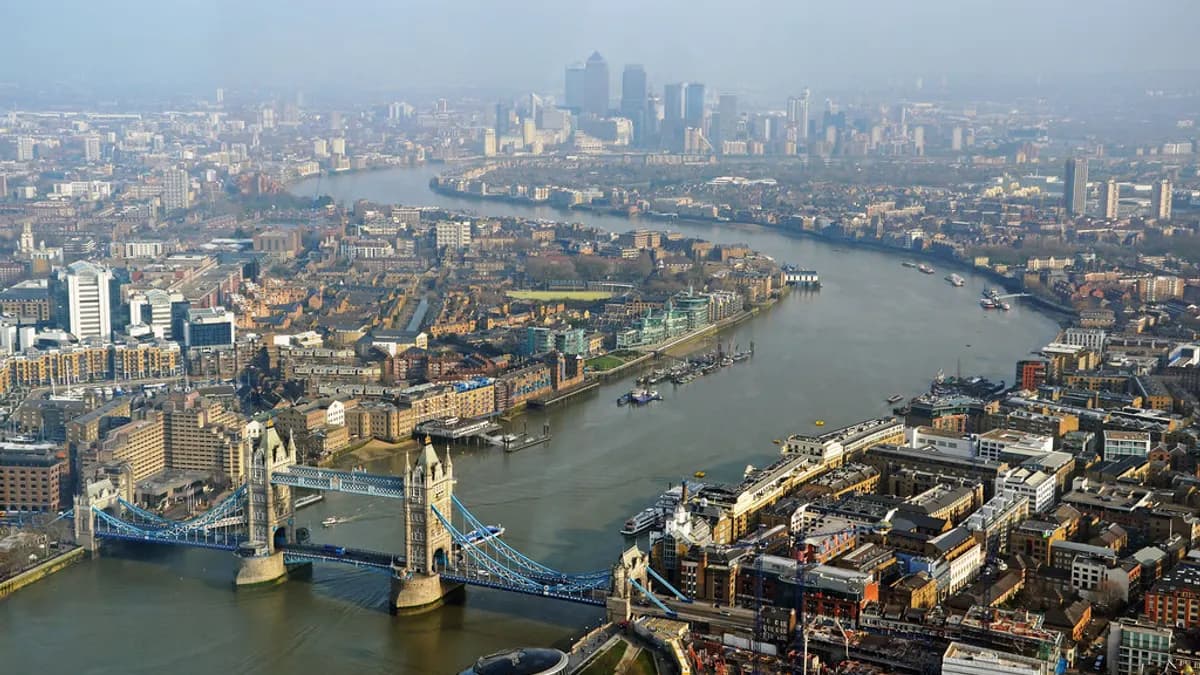
Most private jets to London land at Farnborough (FAB), a business aviation airport about 32 miles southwest of central London, or Biggin Hill (BQH), about 15 miles southeast. Luton (LTN) and Stansted (STN) also serve private flights, mainly for north and east London. From New York, a heavy or ultra long range jet flies nonstop; every passenger also needs a UK ETA or visa.
Key takeaways
- Farnborough is London's dedicated business aviation airport, with an 8,005-foot runway and weekday hours of 7 a.m. to 10 p.m.
- Biggin Hill is the closest of the main business airports to central London, open later on weekdays than Farnborough.
- Luton and Stansted are airline airports with business aviation terminals and long runways, convenient for north and east London.
- Every passenger needs permission to travel, such as an ETA (£20 for US citizens) or visa, and the operator files a General Aviation Report.
- UK departure tax is rising for private jets. From April 2027, the higher rate of Air Passenger Duty extends to private jets of 5.7 tonnes or more.
Which London airports handle private jets?
Four airports handle most private flights to London: Farnborough, Biggin Hill, Luton and Stansted. London City and Oxford play smaller roles, and Heathrow is rarely practical for private flights.
| Airport | Runway (approx.) | Straight-line distance to Mayfair | Best for |
|---|---|---|---|
| Farnborough (FAB) | 8,005 ft | 32 miles | West London, Surrey, Berkshire, large jets |
| Biggin Hill (BQH) | 5,925 ft | 15 miles | Central and south London, Kent |
| Luton (LTN) | 7,090 ft | 27 miles | North London, Hertfordshire, the Midlands |
| Stansted (STN) | 10,000 ft | 31 miles | East London, Essex, Cambridge, very large jets |
| London City (LCY) | 4,950 ft | 9 miles | The City and Canary Wharf, approved aircraft only |
| Oxford (OXF) | 5,010 ft | 55 miles | Oxford, the Cotswolds |
Runway figures are rounded from the open OurAirports dataset and match the airports' own figures where we checked them, such as Biggin Hill's published runway length of 1,806 meters. Distances are straight-line to Mayfair; London traffic can make the drive much longer than the miles suggest.
Why is Farnborough the most popular choice?
Farnborough is built only for business aviation, with a long runway and no airline flights. Private passengers have the airport to themselves.
What to know about Farnborough:
- Runway: about 8,005 feet (2,440 meters), long enough for heavy jets and ultra long range jets on most trips.
- Hours: Rushmoor Borough Council, which sets the planning conditions, says flights are allowed from 7 a.m. to 10 p.m. on weekdays and 8 a.m. to 8 p.m. on weekends and bank holidays. There is no flying on Christmas Day or Boxing Day, except emergencies.
- Location: in Hampshire, about 32 miles from Mayfair in a straight line. It suits west London, Surrey and Berkshire, and the M3 runs into London.
The airport also operates under an annual cap on flights set by its planning permission, with tighter limits at weekends, so weekend slots can be harder to get at busy times.
When is Biggin Hill the better choice?
Biggin Hill is the closest main business aviation airport to central London, and it is open later than Farnborough. It is about 15 miles from Mayfair and 14 miles from the City in a straight line, in the London Borough of Bromley.
- Hours: the airport lists its hours as 6:30 a.m. to 11 p.m. on weekdays and 8 a.m. to 10 p.m. on weekends and public holidays.
- Runway: 1,806 meters (about 5,925 feet). That suits light jets, midsize jets and super midsize jets, and many larger jets on shorter trips. For a large jet departing on a long flight with full fuel, the operator may prefer Farnborough's longer runway.
- Helicopter link: the airport advertises a helicopter shuttle into central London. Ask whether it fits your arrival time.
Biggin Hill is the natural choice for the City, Canary Wharf, south London and Kent, and for late weekday arrivals.
Luton, Stansted, London City and Oxford
These airports fill specific needs.
- Luton is an airline airport about 27 miles north of Mayfair, with a 7,090-foot runway and private terminals operated by FBOs. It is the usual choice for north London, Hertfordshire and the Midlands.
- Stansted has a 10,000-foot runway, the longest of any London airport except Heathrow. It works well for the largest jets and for east London, Essex and Cambridge.
- London City is only about 9 miles from Mayfair and 6 from the City, but it has a short runway and a steep approach, so only aircraft approved for it can land there. Its hours are also restricted, especially at weekends.
- Oxford suits Oxford and the Cotswolds, about 55 miles from central London.
Heathrow accepts private flights, but it is one of the world's busiest airports, slots are scarce and fees are high, so it is rarely the right choice for a charter.
How do you fly a private jet to London from the US?
From the East Coast, a heavy or ultra long range jet flies to London nonstop; from the West Coast, you need an ultra long range jet or a fuel stop. Straight-line distances:
| Departure | To Farnborough | Typical aircraft for nonstop |
|---|---|---|
| Teterboro (New York area) | 2,990 nm | Heavy jet; some super midsize jets eastbound only |
| Palm Beach | 3,780 nm | Heavy or ultra long range jet |
| Van Nuys (Los Angeles) | 4,720 nm | Ultra long range jet |
Westbound flights, from London back to the US, usually face headwinds, so an aircraft that just makes it east may need a fuel stop going home. Common fuel stops include Gander or Goose Bay in Canada, Reykjavik in Iceland and Shannon in Ireland. Use the range explorer to see which aircraft can make your trip nonstop, and the flight time calculator to estimate times.
Aircraft that fly New York to London nonstop with room to spare include the Falcon 7X, the Gulfstream G650ER and the Global 7500.
What paperwork do you need to fly privately to the UK?
Passengers need passports and permission to travel, and the operator files the UK's General Aviation Report.
- Passports for every passenger.
- ETA or visa: US citizens usually need an Electronic Travel Authorisation, which costs £20 and allows stays of up to six months, according to GOV.UK. The UK's general aviation guidance says the operator must check that each passenger holds a valid ETA, visa or other permission to travel. Apply well before the trip.
- General Aviation Report (GAR): the operator submits it to UK Border Force no earlier than 48 hours and no later than 2 hours before departure, according to the UK government's general aviation guidance (February 2026).
- US paperwork: the operator files a CBP eAPIS manifest for the departure and the return, and the first US landing on the way home must be at an airport with customs.
Our guide to flying a private jet internationally explains the US side in more detail.
UK Air Passenger Duty on private jets
The UK charges Air Passenger Duty (APD) per passenger on flights departing the UK, and the rate for private jets is rising.
For flights from 1 April 2026 to 31 March 2027, a flight from the UK to the US falls in Band B (2,001 to 5,500 miles). The GOV.UK rates are:
| Rate | Band B (UK to the US) | Applies to |
|---|---|---|
| Standard rate | £244 per passenger | Many private and business jets today |
| Higher rate | £1,097 per passenger | Aircraft of 20 tonnes or more with fewer than 19 seats |
From April 2027, the higher rate will extend to aircraft of 5.7 tonnes or more used as private or business jets, according to the UK government. That will bring almost every charter jet except the smallest very light jets into the higher rate. For a group of eight flying home from London, the difference between the standard and higher rate in today's Band B figures is more than £6,800.
The operator collects APD and shows it on the invoice. US taxes also apply to international flights; the charter tax calculator estimates the US side.
How much does a private jet to London cost?
The aircraft class is the biggest factor, followed by whether the aircraft waits in London or flies home empty. Typical US on-demand rates per flight hour, before taxes and fees:
| Class | Typical hourly rate | London use |
|---|---|---|
| Super midsize jet | $6,500–9,800 | East Coast to London eastbound, often with a stop westbound |
| Heavy jet | $8,500–13,000 | New York to London nonstop both ways |
| Ultra long range jet | $11,000–17,500 | West Coast to London nonstop, or the most space |
These are typical ranges; quotes vary with season, availability and positioning. On a round trip with a long stay, ask whether it is cheaper for the aircraft to stay in London or to fly home and come back. Use the private jet cost calculator for a budget estimate, and see our guide to New York private jet airports for the US end of the trip.
Planning your trip
For most London trips, Farnborough or Biggin Hill is the right airport, chosen by where you are staying and when you land. Get ETAs sorted early, keep the passenger list final, and budget for UK departure tax, which rises for most private jets in April 2027. Tell us your dates, group size and destination, and request a quote. We will match you with an operator and aircraft that fit the trip.